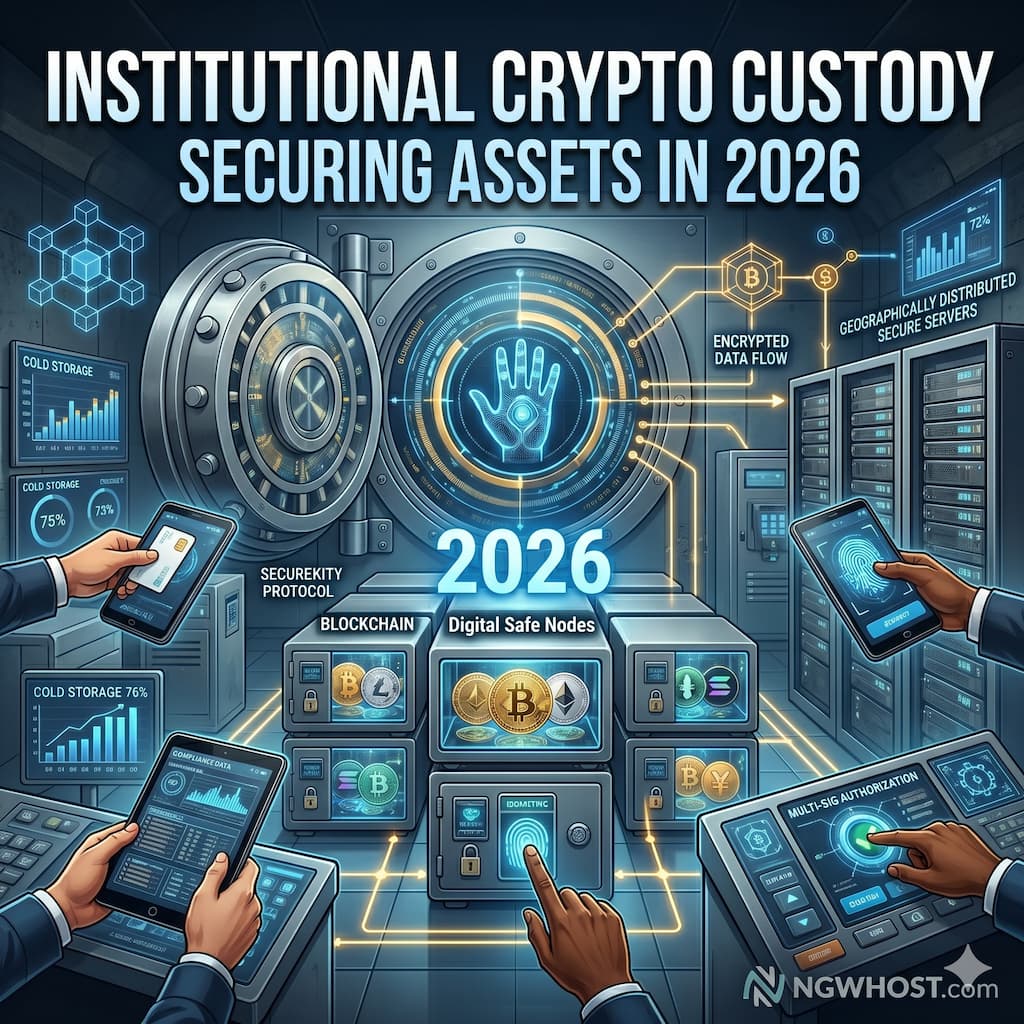
Institutional Crypto Custody: Securing Assets in 2026
The institutional digital asset ecosystem has officially breached its ultimate structural inflection point. As we move through May 2026, the historic perception of cryptocurrencies as volatile, retail-driven speculative instruments has been permanently replaced by a sophisticated financial reality. Driven by massive capital inflows following consecutive spot Bitcoin and Ethereum ETF approvals, landmark legislative milestones like the passage of the CLARITY and GENIUS Acts in the United States, and the Depository Trust & Clearing Corporation (DTCC) moving its DTC Tokenization Service into live production pipelines, digital assets have become a core, normalized component of institutional portfolios.
Global banks, sovereign wealth structures, hedge funds, and multi-platform digital asset treasuries—including the forward-thinking corporate networks within the ngwhost.com community—are no longer debating whether to allocate capital to distributed ledgers. Instead, the strategic conversation has centered exclusively on a much more complex, gating operational variable: Scrutiny-Ready Institutional Custody.
    THE 2026 CUSTODY SCALING ENGINE
┌──────────────────────────────────────────────────┐
│ SURGING INSTITUTIONAL CAPITAL (ETFs & Tokenization)│
└────────────────────────┬─────────────────────────┘
                         │
                         ▼
┌──────────────────────────────────────────────────┐
│ STRICT COMPLIANCE SCALABILITY (EU AI Act / SEC)   │
└────────────────────────┬─────────────────────────┘
                         │
                         ▼
┌──────────────────────────────────────────────────┐
│  ADVANCED ENTERPRISE CRYPTOGRAPHIC ARCHITECTURE  │
│  * Multi-Party Computation (MPC)                 │
│  * Hardware Security Modules (HSMs)              │
│  * Real-Time Programmatic Auditing               │
└──────────────────────────────────────────────────┘
In an era where company boards, investment committees, and external auditors enforce absolute risk ownership, the amateur “hardware wallet in a bank vault” model is dead. Modern fiduciary standards demand multi-layered security frameworks that can protect billions in on-chain assets from advanced cyber threats while delivering real-time programmatic liquidity, integrated staking yields, and strict multi-jurisdictional compliance.
This enterprise brief delivers a comprehensive technical analysis of the 2026 Institutional Crypto Custody Stack, maps out the core cryptographic and legal standards safeguarding assets, and provides a tactical framework to build a resilient, multi-custodian corporate defense grid this year.
1. The 2026 Paradigm Shift: From Cold Storage to Dynamic Operational Infrastructure
To properly architect a digital asset safekeeping strategy today, you must dismantle the outdated assumption that custody is merely a passive “lock-and-key” mechanism. The evolution of institutional key management can be divided into three distinct generational waves:
- The Isolated Cold Era (The First Wave): Primitive air-gapped security. Private keys were generated on disconnected computers, split into physical fragments, and stored in physical deep-storage vaults. While highly secure against remote network intrusions, this model introduced massive Liquidity Paralysis—executing a single transaction or rebalancing a position often required manual, multi-hour verification procedures, rendering rapid trading or active treasury management impossible.
- The Connected Hot Era (The Second Wave): High-velocity, high-exposure risk. To facilitate active trading and real-time API integrations, organizations stored private keys on network-connected cloud servers. This maximized transaction speeds but created a highly lucrative, centralized honey pot for sophisticated hacker syndicates, leading to catastrophic exploit vectors and smart-contract vulnerabilities.
- The Hybrid Agentic Era (The Third Wave): The 2026 benchmark. Institutional custody has evolved into a dynamic workflow automation layer. By combining distributed cryptographic key generation with zero-trust policy engines, modern custodians offer Bank-Grade Cold Security at Hot-Wallet Speeds. Assets remain fully ring-fenced and segregated off-balance-sheet, yet they can be mobilized, staked, or settled across multi-venue trading networks within a sub-15-minute execution window.
According to 2026 financial industry benchmark data, regulatory compliance and cryptographic signing security have risen to become the single largest decision drivers for institutional allocators, with 61% of institutions now deploying a highly redundant, Multi-Custodian Model to eliminate single points of operational failure.
2. Core Cryptographic and Architectural Pillars of Modern Digital Custody
Securing digital assets at scale requires transitioning away from traditional singular private key architectures. Elite 2026 custodians construct their platforms around four foundational technological layers.
I. Multi-Party Computation (MPC) Key Sharding
The absolute standard for modern digital asset security is Multi-Party Computation (MPC). Traditional multi-signature setups require distinct private keys to sign a transaction, which can clog network pipelines and increase on-chain transaction fees across non-native chains.
- The Cryptographic Breakthrough: MPC eliminates the creation of a singular, whole private key at any point in the asset lifecycle. Instead, the mathematical key is split into distinct, encrypted Key Shares (Shards) generated independently across isolated geographic nodes and trusted execution environments (TEEs).
- The Execution: When a transaction is initiated, the nodes execute a distributed mathematical protocol to sign the data packet without ever revealing, transmitting, or reconstructing their individual shares. There is no single private key for an internal rogue employee to steal, nor a central server location for an external hacker to exploit.
II. Hardware Security Modules (HSMs) and Air-Gapped Isolation
Cryptographic code is only as safe as the physical silicon it runs on. 2026 enterprise custody stacks mandate that MPC protocols occur strictly within specialized, dedicated Hardware Security Modules (HSMs) rated at Federal Information Processing Standards (FIPS) 140-3 Level 4 compliance. These physical computing enclaves feature tamper-evident coatings, automated cryptographic self-destruction mechanisms if physical intrusion is detected, and strict electrical isolation, completely shielding the signing environment from side-channel or localized physical hardware attacks.
III. Granular Programmatic Policy and Governance Engines
The primary vector for institutional asset loss is no longer external software hacks; it is Internal Collusion and Operational Workflow Failures. Modern custody consoles prevent this through deep API-driven policy layers.
- The Shield: Organizations configure highly complex, un-alterable corporate approval matrices directly into the custodian’s governance engine. For instance, a treasury sweep transfer under $50,000 might require only a automated system confirmation. A transfer exceeding $1,000,000, however, automatically triggers a multi-sig biometric validation sequence requiring cryptographic signatures from the CFO, the Risk Director, and an external compliance auditor—completely blocking unauthorized capital flights.
IV. Real-Time On-Chain Auditability and Proof of Reserves (PoR)
Leaving corporate capital inside an exchange wallet or an un-audited centralized registry introduces catastrophic counterparty risk. The 2026 regulatory standard dictates that institutional custodians must maintain absolute On-Chain Balance Sheet Segregation. Client assets are completely ring-fenced in distinct on-chain addresses, completely isolated from the custodian’s operating capital. The custodian provides real-time, API-driven Proof of Reserves (PoR) utilizing zero-knowledge cryptographic proofs, allowing external corporate auditors to verify the absolute presence and safety of every individual token row at any second of the day.
3. The 2026 Institutional Custody Matrix: Premier Market Providers
To successfully scale a secure digital treasury infrastructure on ngwhost.com, you must align your asset storage parameters with qualified, fully licensed custodians that match your operational jurisdiction. The 2026 marketplace is led by powerful enterprise-grade banking and native-crypto platforms:
| Custodial Institution | Primary Regulatory Status | Standout 2026 Core Feature | Ideal Corporate Use Case |
| Coinbase Prime Custody | New York Banking Law Qualified Custodian | Prime Stack Integration: Deeply pairs institutional cold storage with multi-venue OTC liquidity and execution. | US-regulated funds, corporate treasuries, and spot ETF issuers. |
| Fidelity Digital Assets | SEC & TradFi Regulated Entity | TradFi Risk Management: Implements strict legacy banking operational due diligence and compliance rigor. | Institutional asset managers requiring familiar oversight structures. |
| Anchorage Digital Bank | US OCC Federal Bank Charter | Federal Banking Oversight: Operates under explicit federal banking laws with institutional-grade regulatory air-covers. | High-net-worth family offices and federal corporate trusts. |
| Zodia Custody | Bank-Backed (SC Ventures / Johnstons) | Banking Environment Convergence: Seamlessly bridges digital asset infrastructure directly into global tier-1 banking systems. | EMEA and APAC multi-licensed enterprises requiring global compliance. |
| BitGo / Fireblocks | Multi-Jurisdictional API Platforms | Programmable Policy Tooling: Provides elite, developer-first API frameworks and advanced custom policy engines. | High-frequency trading funds and tech-forward e-commerce networks. |
4. Operationalizing Crypto Security: A 3-Step Scaling Blueprint
Transitioning your enterprise from loose, manual wallet setups to a bulletproof, institutional-grade asset defense grid requires a systematic, architecturally sound roadmap.
Step 1: Architect a Multi-Custodian Redundancy Perimeter
Never consolidate 100% of your corporate digital reserves into a single custodial platform. Map out a diversified network layout that mirrors the high-availability, redundant design of enterprise cloud hosting clusters.
Distribute your digital capital across at least two distinct, qualified custodians using an optimized allocation rule: use an enterprise banking custodian (like BNY Mellon or Fidelity) to secure your foundational, long-term asset reserves, and deploy a developer-first MPC custodian (like Fireblocks or BitGo) to handle active, real-time programmatic operational flows and staking loops.
Step 2: Implement Real-Time AI-Driven Anomaly Sensing
The speed of on-chain transaction settlement means that if an un-authorized or malicious transaction escapes your perimeter, the capital leaves your custody irreversibly in seconds.
- The Automation Enclave: Connect your custodial API consoles directly to specialized AI-Powered Transaction Monitors.
- The Execution: The machine learning engines run continuous, real-time behavioral analysis on every transaction request. If the system spots an outbound transaction that deviates from your historical data profiles—such as an uncharacteristic smart-contract interaction destination, an unexpected velocity surge, or a request initiated outside standard corporate operational hours—the monitor triggers an automated, programmatic quarantine on the custodial node, freezing the transaction until manual human verification is completed.
  [Outbound Transaction Request]
                 │
                 ▼
┌────────────────────────────────────────────────┐
│   AI Real-Time Behavioral Analytics Engine     │
├────────────────────────────────────────────────┤
│ * Checks historical destination profiles       │
│ * Verifies corporate spending velocities      │
│ * Audits timestamp network signatures          │
└────────────────┬───────────────────────────────┘
                 │
        ┌────────┴────────┐
        ▼                 ▼
  [Normal Behavior]  [Anomalous Signal Spotted]
        │                 │
        ▼                 ▼
  [Instant Release]  [Automated Quarantine Enclave Layer]
                          │
                          ▼
                     [Manual Executive Review Required]
Step 3: Establish a Quantum-Resistant Encryption Roadmap
As detailed in recent 2026 cryptographic security updates, the rapid evolution of quantum computing architectures poses a structural long-term threat to traditional elliptic curve cryptography (such as ECDSA) that underpins basic blockchain key signatures.
When auditing your custodian options this year, verify that their technical engineering roadmaps include explicit migration timelines toward Post-Quantum Cryptography (PQC) Standards (such as NIST-approved ML-DSA and Falcon algorithms). Ensure your assets are insulated from future decryption risks long before traditional encryption baselines face deprecation.
5. Critical Risks: Navigating the Modern Security Obstacles
Maintaining an ironclad institutional digital asset posture requires continuous vigilance against sophisticated new threat vectors:
- The Hazard of AI-Generated Inside Collusion: Cybercriminal networks now deploy highly advanced generative deepfake technologies to target internal corporate executives. A malicious actor can execute a hyper-realistic audio and video deepfake of a company’s CEO during a live virtual meeting, instructing a treasury manager to override internal compliance policies and initiate an emergency capital release from custody. Organizations must mandate out-of-band physical authentication keys and unique, offline cryptographic phrase verifications for all high-value transactions.
- The Slashing Vulnerability in Staking Operations: For enterprises looking to maximize capital efficiency by staking their Ethereum or asset balances directly from custody to capture native yields, choosing the wrong validation node introduces severe risks. If an underlying validator node experiences a long-term network drop or executes a double-signing error, the blockchain network inflicts a permanent Slashing Penalty, burning a portion of your principal capital. Institutional investors must ensure their custody contracts feature explicit, comprehensive Slashing Insurance Coverage.
- The Trap of Commingled Multi-Asset Infrastructure: Avoid lower-tier, un-regulated digital asset platforms that utilize unified, aggregated omnibus wallets to pool corporate assets together with retail trader funds. If a sudden market liquidity crisis or regulatory freeze hits the platform’s broader retail client base, your corporate treasury capital will be instantly trapped inside the broader legal liquidation estate. Demand absolute, off-balance-sheet ring-fenced asset segregation backed by explicit qualified custodian legal certifications.
6. The Technological Synergy: Redundant Systems for Digital Assets
For the technical directors, cloud systems engineers, and infrastructure architects who anchor their enterprise applications to ngwhost.com, the principles of institutional crypto custody are completely second nature.
When you configure an enterprise hosting layout or an enterprise corporate cloud network, you do not tolerate single points of failure. You don’t leave your system architecture vulnerable to a single compromised password or a localized power failure. You engineer systemic redundancy: you split workflows across distinct processing regions, utilize hardware-isolated firewalls, enforce multi-factor identity access tokens, and maintain encrypted, real-time database backups to ensure that if a critical server cluster drops offline, the broader platform continues to render flawlessly without capital or data corruption.
An allocation into an automated Institutional MPC Crypto Custody Stack is simply extending that exact same systemic, multi-layered structural redundancy to your company’s monetary assets:
- Your MPC Key Shards and Hardware HSM Enclaves operate as your isolated, multi-region database clusters, ensuring that your core cryptographic secrets remain completely un-compromised even if an individual server node faces a total security breach.
- Your Programmatic Policy Engines and Biometric Approval Gates act as your resilient, enterprise-grade firewalls, silently auditing internal corporate movements, blocking unauthorized capital flights, and protecting your balance sheet from internal fraud vectors.
- Your On-Chain Segregation and Real-Time Auditing APIs behave as your secure, immutable system logs, certifying to your external regulators, internal investors, and board members that your sovereign capital is completely protected from counterparty risks.
By mastering this technical configuration, you eliminate operational risk, strip away infrastructure vulnerabilities, and position your digital brand to scale at terminal velocity while maintaining total, absolute financial sovereignty over the global enterprise you built.
Read More⚡ Inflation-Indexed Bonds: Safe Haven Strategies 2026
Conclusion: The Era of Un-Breachable Sovereignty
The integration of digital assets into the global financial mainstream is an accomplished reality of 2026. But the massive competitive leverage delivered by decentralized ledgers is entirely dependent on the security of the underlying cryptographic keys. Relying on retail-grade storage methods or un-regulated, opaque platforms is an existential vulnerability that endangers your corporate equity, your institutional clients, and your long-term market position.
Securing your capital within this high-velocity environment is an exact discipline of precise cryptographic configuration and rigorous corporate governance. By executing a strict multi-custodian diversification strategy, routing your pipelines through FIPS-compliant HSM enclaves, deploying continuous real-time behavioral anomaly monitors, and enforcing absolute off-balance-sheet asset segregation, you effectively neutralize the risks of digital asset ownership.
The global economy is accelerating onto on-chain networks. Build your security perimeter with absolute architectural precision, protect your private keys fiercely, and let your corporate treasury scale with absolute predictability.