Venture Capital Trends: Where the Money is Flowing Now
The venture capital (VC) ecosystem in May 2026 has entered a new epoch. We have moved definitively past the post-pandemic correction of the early 2020s and into a cycle defined by high-conviction concentration, the industrialization of AI, and a massive pivot toward physical infrastructure.
For the readers of ngwhost.com, understanding these trends is not just for investors; it is a roadmap for founders and tech administrators to see where the next decade of infrastructure is being built. In Q1 2026 alone, global venture funding shattered records, reaching a staggering $300 billion—a 150% increase year-over-year.
In this deep dive, we explore the “Big Shifts” of 2026, the sectors attracting mega-rounds, and the new rules of the venture game.
1. The Era of “AI Gravity”
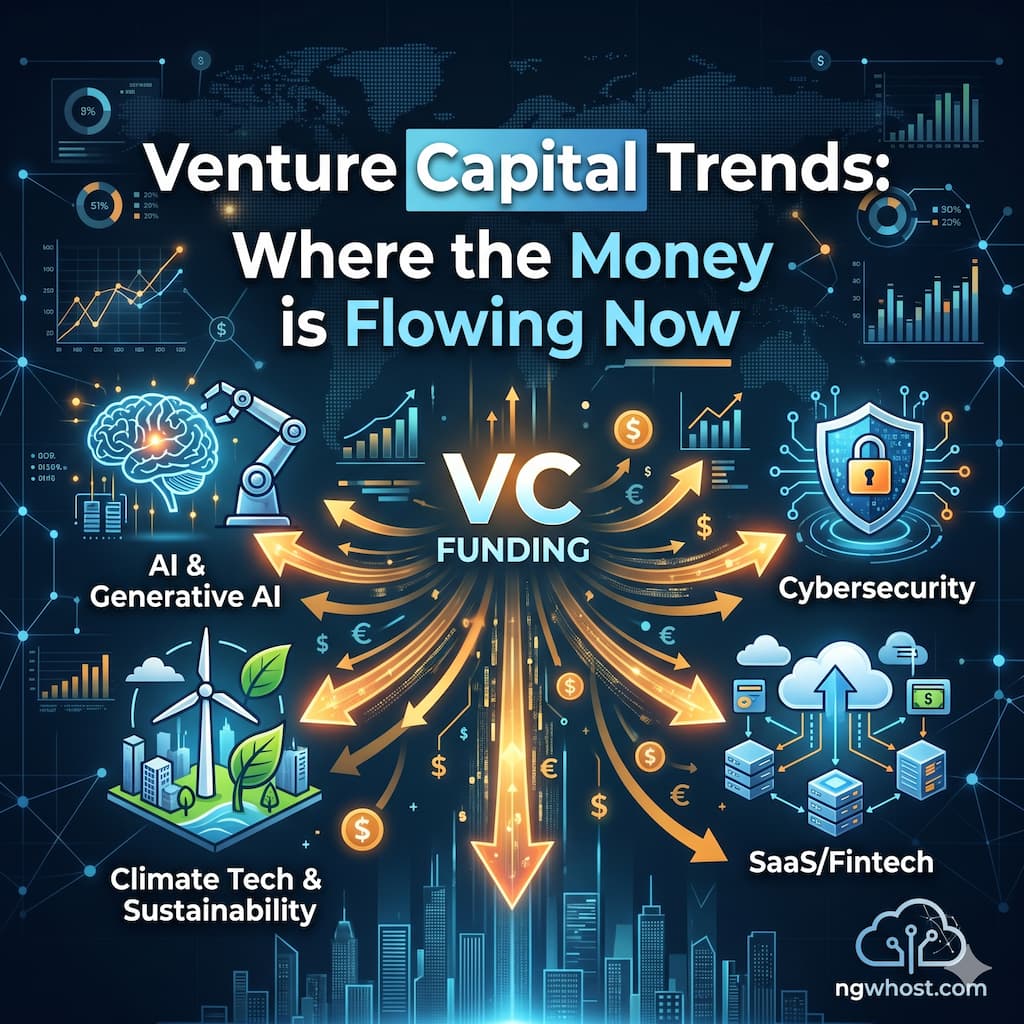
In 2026, Artificial Intelligence is no longer a “sector”—it is the reference layer for all of venture capital. Approximately 80% of all venture dollars in Q1 were directed toward AI-related companies. However, the nature of these investments has matured from simple chatbots to massive infrastructure and specialized applications.
Frontier Labs and the Compute Arms Race
The capital flowing into “Frontier Labs” has reached unprecedented scales. In the first few months of 2026, we saw historic rounds that dwarfed previous cycles:
- OpenAI: $122 billion
- Anthropic: $30 billion
- xAI: $20 billion
This “mega-round” activity signals that VCs are placing massive bets on the companies building the underlying models that will power the global economy. For hosting and server professionals at ngwhost.com, this translates to an insatiable demand for high-performance data centers and specialized chips.
From Productivity to “Agentic” AI
While 2024 was about assistants, 2026 is about Agents. Money is flowing into startups building autonomous systems capable of executing multi-step business workflows—from legal discovery to automated procurement—without human intervention. Investors are prioritizing “Applied AI” companies that can demonstrate real-world monetization rather than just “cool” prototypes.
2. The Physical World: Robotics and Autonomous Mobility
One of the most striking trends of 2026 is the return to the Physical World. Venture capital is no longer just about software; it is about bits meeting atoms.
Autonomous Vehicles (AV) 2.0
The “AV Winter” is officially over. In May 2026, funding for autonomous mobility has consolidated around a small group of leaders. Waymo secured a massive $16 billion raise recently, signaling that investors believe the technology is finally ready for mass-scale commercialization. The money is flowing into:
- Robotaxi Fleets: Scaling urban transportation.
- Autonomous Logistics: Long-haul trucking and last-mile delivery drones.
- Physical Infrastructure: Smart sensors and 5G/6G connectivity required to manage autonomous traffic.
The Industrial Robotics Boom
Labor shortages and rising costs have pushed VCs to pour capital into Warehouse and Factory Automation. In 2026, facilities leveraging advanced robotics are seeing productivity gains of up to 50%, making these startups highly attractive to growth-stage funds.
3. Climate Tech and the Energy-AI Nexus
In 2026, the energy sector has become a primary focus for venture capital, largely driven by the massive power requirements of AI compute.
Powering the Data Center
The energy sector necessary for AI compute garnered significant funding this year. VCs are investing heavily in:
- Small Modular Reactors (SMRs): To provide clean, dedicated power to data center clusters.
- Next-Gen Battery Storage: Ensuring 24/7 uptime for renewable-powered clouds.
- Power Management Solutions: Software and hardware that optimize electricity usage at the chip level.
Carbon Management and Decarbonization
Sustainability remains a core theme, but the focus has shifted toward Industrial Decarbonization. Money is flowing into “DeepTech” startups that are reinventing cement, steel, and chemical manufacturing to meet 2030 climate targets.
4. The Exit Environment: IPOs and M&A in 2026
After years of limited liquidity, the “Exit Window” has partially reopened in 2026, though it remains highly selective.
The IPO Rebound
Goldman Sachs analysts have forecasted that US IPO proceeds could reach $160 billion this year. Marquee names like SpaceX, OpenAI, and Anthropic are edging closer to public listings. However, public investors are no longer buying “growth at all costs.” To go public in 2026, companies must show:
- Cash Flow Visibility: A clear path to profitability.
- Disciplined Governance: Strong boards and transparent reporting.
- Defensible Moats: Proprietary data or infrastructure that AI cannot easily replicate.
M&A as the Primary Liquidity Driver
For the vast majority of startups, Mergers and Acquisitions remain the primary goal. Corporate Venture Capital (CVC) arms are aggressively acquiring AI and cybersecurity startups to accelerate their own digital transformations. Technology M&A volume in 2025 was up 66%, a trend that has accelerated into May 2026.
5. Regional Shifts: Where the Hubs are Moving
While Silicon Valley remains the epicenter, 2026 has seen a significant diversification of where money is flowing geographically.
- Europe: Roughly half of European venture funding in 2026 to date has been AI-driven. The region is leveraging its strength in industrial sectors and deep technical talent.
- Middle East: Driven by “Vision 2030” roadmaps, sovereign wealth funds in the Middle East have become critical LPs (Limited Partners) and direct investors in global tech.
- Latin America & Africa: These regions are leading the world in Stablecoin and Fintech utility. Where traditional banking is inefficient, VCs are funding blockchain-based settlement and payment infrastructure.
6. Emerging Sectors to Watch (The “Niche” Alpha)
While AI and AV take the headlines, smart money is moving into “periphery” deals that support the new tech stack:
- Cybersecurity for AI: Protecting companies from “Model Poisoning” and AI-driven deepfakes.
- Defense Tech: Modernizing the military with autonomous drones and predictive intelligence.
- Digital Health: AI-native diagnostic tools and personalized longevity medicine.
- Stablecoin Infrastructure: Real-world utility in cross-border remittances and global B2B payments.
Read More⚡ Algorithmic Trading: AI Tools for Investors 2026
Conclusion: The New “Standard” for Founders
In May 2026, the venture market is open but selective. The “spray and pray” model of 2021 has been replaced by a “sorting machine” that favors category leaders with clear business models.
For the ngwhost.com community, the takeaway is clear: Value is being created where Digital Intelligence meets Physical Reality. Whether you are building an AI-native app or managing the servers that host it, the money is flowing toward efficiency, automation, and the massive infrastructure needed to power the next twenty years of innovation.
The capital is there. The technology is ready. The window is open.