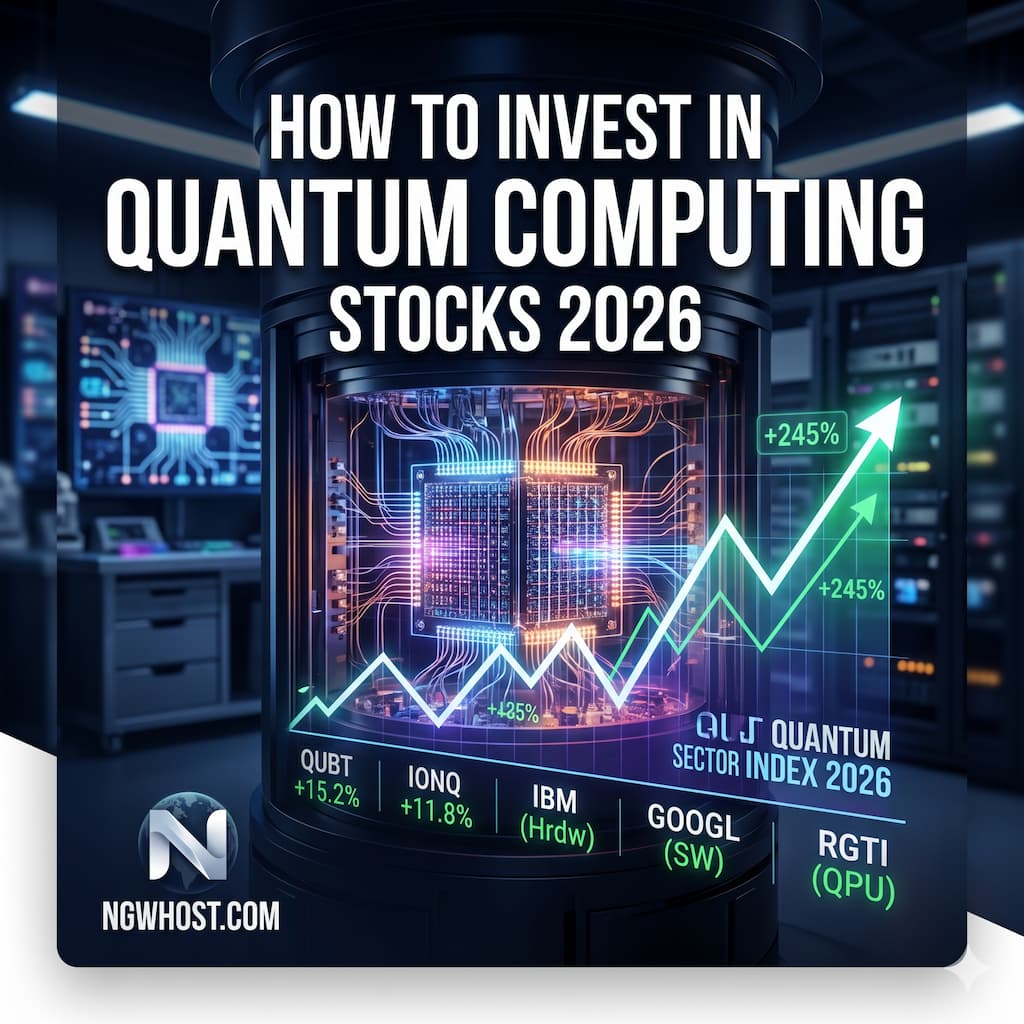
How to Invest in Quantum Computing Stocks 2026
For anyone following the tech sector, 2026 has become the year the “Quantum Dream” finally started to show real teeth. We have moved past the era of pure academic theory and entered a phase of industrial-scale roadmaps. For investors, this is the frontier—a high-stakes, high-reward landscape that looks a lot like the early days of the internet or the AI boom of 2023.
If you are looking to position your portfolio for the next decade of compute, this guide will break down the “how,” the “who,” and the “why” of investing in quantum computing stocks in 2026.
Why 2026 is the Turning Point
For years, quantum computing was plagued by the “Noisy Intermediate-Scale Quantum” (NISQ) problem. The machines were powerful but incredibly prone to errors caused by heat, light, or even slight vibrations.
However, mid-2026 has brought us two critical milestones:
- The Error Correction Breakthrough: In early 2026, Google’s Willow chip and IBM’s Heron R2 processors demonstrated “below-threshold” error correction. This means we can finally add more qubits to a system to reduce errors rather than amplify them.
- The Hybrid Integration: Led by Nvidia’s Ising AI model family (launched in May 2026), we are now seeing quantum processors working in tandem with classical GPUs. This “hybrid” approach is the bridge that allows enterprises to actually use quantum power today for specific optimization problems.
The “Barbell Strategy”: How to Structure Your Portfolio
Investing in quantum is not like investing in a blue-chip retail stock. It is speculative. The most successful investors in 2026 are using the Barbell Strategy:
- One End (The Weights): Massive, diversified tech giants (IBM, Google, Microsoft, Nvidia) that provide safety and steady growth, using quantum as a “call option” for the future.
- The Other End (The Upside): High-risk, high-reward “pure-plays” (IonQ, Rigetti, D-Wave) that could go to zero—or provide 100x returns.
Top Quantum Computing Stocks to Watch in 2026
1. The Pure-Plays: High Octane, High Risk
These companies live and die by their quantum hardware. If they achieve “Quantum Advantage” first, their stock prices will likely decouple from the broader market.
IonQ (IONQ)
IonQ remains the leader in the trapped-ion architecture. Unlike superconducting qubits that require extreme cooling, IonQ’s qubits are suspended in a vacuum, leading to higher fidelity.
- 2026 Milestone: The company is currently targeting its 256-qubit system for late 2026.
- The Play: IonQ has become the primary partner for cloud providers (AWS, Azure). If you believe “Precision over Speed” is the winning formula, IonQ is your pick.
D-Wave Quantum (QBTS)
D-Wave is the “odd one out” because they focus on Quantum Annealing rather than gate-based computing. While some purists argue this isn’t “true” quantum, D-Wave is the only company with a significant commercial book of business in 2026.
- The Play: They are winning contracts in logistics and supply chain optimization (including a recent $20M deal with major universities and Fortune 100 buyers). Invest here if you want a company that is solving real-world business problems right now.
Rigetti Computing (RGTI)
Rigetti uses a modular superconducting approach. Their Cepheus-1 system (108 qubits) reached general availability in Q1 2026.
- The Play: Rigetti owns its own fabrication plant (Fab-1), which gives them a massive advantage in controlling the supply chain. However, they are highly dependent on government and defense contracts.
2. The Infrastructure Giants: The “Picks and Shovels”
If you don’t want to bet on which quantum architecture wins (Trapped-Ion vs. Superconducting vs. Photonic), bet on the companies providing the tools.
Nvidia (NVDA)
In 2026, Nvidia is no longer just a “GPU company.” Their launch of the Ising AI model family has solidified them as the middleware of the quantum world. Their CUDA-Q platform is becoming the industry standard for programming hybrid quantum-classical systems.
- The Play: Nvidia wins regardless of which hardware company survives, as everyone will need their infrastructure to run the algorithms.
IBM (IBM)
IBM has the deepest enterprise sales motion in the world. With their June 2026 blueprint for a fault-tolerant quantum supercomputer, they are positioning themselves as the “safe” way to play the sector.
- The Play: IBM’s Heron chip is already powering cloud systems in the US and EU. This is for the investor who wants dividends and stability alongside a front-row seat to the quantum revolution.
Alphabet (GOOGL)
Google’s Quantum AI division is arguably the most scientifically advanced. Their prediction that quantum will break current blockchain encryption as soon as 2029 (published in late 2025) has sent shockwaves through the cybersecurity industry.
- The Play: You are buying a search engine and AI powerhouse, with a “lottery ticket” in the form of the world’s most advanced quantum research team.
Sector-Specific Opportunities
As we move through 2026, keep an eye on how these stocks interact with specific industries:
- Pharmaceuticals: Quantum is being used to simulate mRNA sequences (Modern/IBM collaboration). This could cut drug discovery from years to weeks.
- Finance (BFSI): Goldman Sachs and JPMorgan are already testing quantum for “Monte Carlo simulations” to price complex derivatives.
- Materials Science: Microsoft’s Majorana 1 chip is currently being used to model molecular interactions for better battery tech.
The Risks: What Could Go Wrong?
While the hype is real, the risks in 2026 remain significant:
- The “Quantum Winter”: If these companies fail to deliver a clear commercial “Quantum Advantage” by 2027, the funding could dry up, leading to a massive crash in pure-play stocks.
- Dilution: Many pure-plays like Rigetti and IonQ are still burning cash. Expect them to issue more shares to fund their R&D, which can dilute your investment.
- Cybersecurity Panic: If a “Q-Day” (when quantum breaks all encryption) looks closer than expected, it could cause systemic instability in the tech sector.
Read More⚡ Retirement Planning for Entrepreneurs: The 2026 Guide
Strategy for ngwhost.com Investors
If you are looking to build a position in 2026, follow these three rules:
- Think Fractional: Don’t go all-in on one name. Use fractional shares to build a “Quantum Basket.”
- Focus on Fidelity, Not Just Qubits: A 100-qubit machine with 99.99% accuracy is worth more than a 1,000-qubit machine that makes errors every third step.
- HODL (The 5-Year Window): Quantum is a marathon. The real explosion in value is expected between 2028 and 2032. If you can’t hold for five years, this isn’t the sector for you.
Summary Table: Quantum Stock Outlook 2026
| Ticker | Technology | Risk Profile | 2026 Catalyst |
| IONQ | Trapped-Ion | High | 256-qubit system launch |
| QBTS | Annealing | Medium | Commercial optimization contracts |
| IBM | Superconducting | Low | Heron R2 cloud integration |
| NVDA | Hybrid Infrastructure | Low | Ising AI model adoption |
| RGTI | Superconducting | Very High | Fab-1 production scaling |
Conclusion: Quantum computing in 2026 is no longer a “maybe”—it’s a “when.” By balancing the stability of Big Tech with the explosive potential of pure-play startups, you can position your portfolio for the largest paradigm shift in computing history.
Stay curious, stay diversified, and keep an eye on those fidelity scores.