Central Banks and AI: Predicting Market Crashes
In the financial architecture of 2026, the “Lender of Last Resort” has evolved into the “Analyzer of Every Byte.” Central banks—the institutions that once relied on lagging quarterly indicators and manual spreadsheets—are now operating at the speed of light. As global markets become increasingly interconnected and volatile, the Federal Reserve, the European Central Bank (ECB), and the Bank of Japan are turning to a new weapon: Artificial Intelligence.
For investors following ngwhost.com, understanding the intersection of monetary policy and machine learning is no longer optional. It is the key to understanding why markets move, how bubbles are identified, and whether AI can truly prevent the next “Black Swan” event. This exploration dives into the sophisticated world of algorithmic central banking and the quest to predict market crashes before they happen.
1. The Death of Lagging Indicators
Historically, central banks were always “fighting the last war.” By the time inflation data or employment figures were finalized, the economic shift had already occurred. This delay often led to policy errors—raising rates too late or cutting them too early.
Real-Time Economic “Nowcasting”
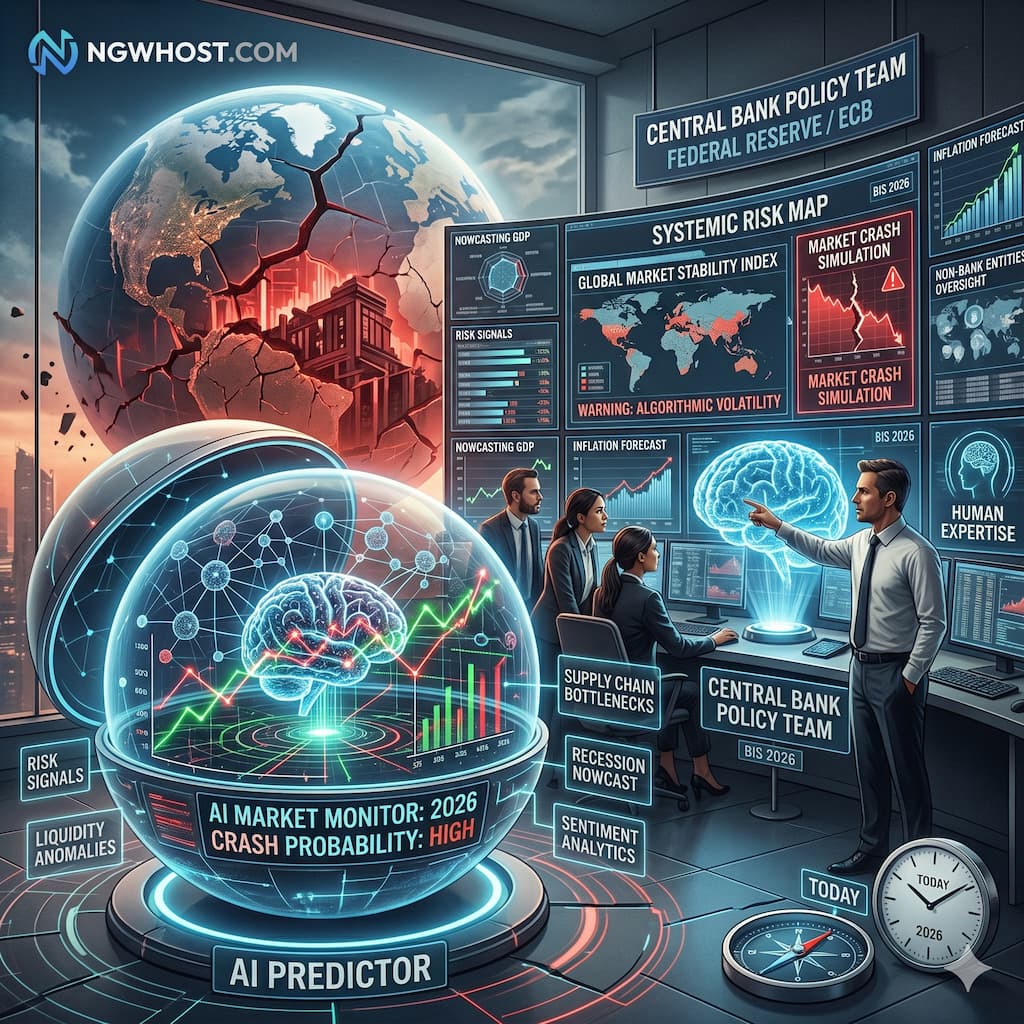
AI has introduced the concept of Nowcasting. Central banks now use Large Language Models (LLMs) and neural networks to scrape millions of data points every second:
- Satellite Imagery: Analyzing parking lot density at major retailers to gauge consumer spending.
- Shipping Manifests: Tracking global trade flow in real-time to predict supply chain bottlenecks.
- Digital Footprints: Using anonymized credit card transactions and job board listings to assess the health of the economy today, not three months ago.
By processing this “Alternative Data,” central banks can sense a slowdown long before it appears in official government reports.
2. AI and the Detection of Asset Bubbles
A market crash is almost always preceded by an unsustainable bubble. The challenge for humans has always been distinguishing between “innovation-driven growth” and “irrational exuberance.”
Pattern Recognition in Market Psychology
AI excels at identifying patterns that the human eye misses. Central bank algorithms are now trained on decades of historical crash data—1929, 1987, 2008, and the “Flash Crashes” of the 2010s.
- Leverage Tracking: AI monitors the hidden layers of the shadow banking system, identifying where excessive debt is accumulating.
- Correlation Anomaly Detection: When asset classes that usually move in opposite directions suddenly start moving together, AI flags this as a sign of systemic fragility.
When the algorithm sees the same “mathematical signature” that preceded the 2008 Lehman Brothers collapse, it triggers an internal red alert, allowing governors to adjust liquidity before the bubble bursts.
3. NLP: Analyzing the “Vibe” of the Market
One of the most powerful tools in a central bank’s AI arsenal is Natural Language Processing (NLP). Markets are moved by narratives and emotions as much as they are by numbers.
Sentiment Analysis of the Global Conversation
Central banks use NLP to monitor:
- Earnings Calls: Analyzing the tone of CEOs. Are they truly confident, or is their language becoming increasingly defensive?
- Social Media & News: Tracking the velocity of “fear-based” keywords. If terms like “default,” “liquidity crisis,” or “bank run” begin to trend exponentially, the AI alerts policymakers to a potential panic in the making.
- Policy Transparency: Interestingly, AI is also used to “reverse-test” the central bank’s own communications. Before a Fed Chair speaks, they may use AI to predict how the market will react to specific phrases, ensuring they don’t accidentally trigger a sell-off.
4. Can AI Truly Predict a Crash? The “Ooda Loop” Challenge
While AI is incredibly powerful, the question remains: Can it actually predict a crash with a specific date and time?
The Complexity of Human Behavior
The “Ooda Loop” (Observe, Orient, Decide, Act) in finance is tricky. If a central bank’s AI predicts a crash and the bank takes action to stop it, the crash doesn’t happen. Did the AI “predict” incorrectly, or did the intervention work? This creates a feedback loop where the observer influences the observed.
The Problem of “Black Swans”
AI is trained on past data. By definition, a Black Swan event is something that has never happened before (like a global pandemic in 2020 or a specific type of cyber-warfare in 2026). AI struggles with “Zero-Day” events because there is no historical pattern to reference. In these moments, the AI may actually exacerbate the crash by executing automated sell-orders, a phenomenon known as Algorithmic Contagion.
5. The Risks of Algorithmic Central Banking
As central banks lean harder on AI, new risks emerge for the global financial system.
- The “Black Box” Problem: If an AI model at the ECB suggests a massive interest rate hike to prevent a crash, but the human governors can’t explain why the AI reached that conclusion, should they follow it? This lack of “explainability” creates a democratic deficit in monetary policy.
- Market Homogenization: If every major central bank and every hedge fund is using the same AI models, they will all try to exit the market at the same time. This turns a “correction” into a “crash” through sheer synchronization.
- Adversarial AI: Hostile actors or rogue algorithmic traders could theoretically “spoof” the data that central bank AIs rely on, creating fake signals of a crash to force a policy change that benefits the attacker.
6. How Investors Should Adapt
At ngwhost.com, we believe the rise of AI-driven central banking changes the game for individual investors.
1. Watch the “Signals,” Not Just the News
Official news is now the “last” place information arrives. Investors should look at platforms that provide AI-driven sentiment analysis and real-time data flow.
2. Prepare for Faster Cycles
Because AI identifies and reacts to problems faster, the “boom and bust” cycles are becoming shorter and more intense. The “V-shaped” recovery is no longer an anomaly; it is the standard in an AI-managed economy.
3. Diversify Against “Algo-Risk”
Hold assets that aren’t strictly tied to digital liquidity. Physical assets, decentralized finance (DeFi), and commodities provide a hedge against a “glitch” in the central bank’s AI infrastructure.
7. The Future: AI as the “Grand Stabilizer”?
By 2030, we may see the first “Autonomous Monetary Policy,” where AI handles the day-to-day liquidity management of a nation’s currency within strictly defined human guardrails.
The goal isn’t to eliminate market movements—volatility is a natural part of price discovery. The goal is to eliminate Systemic Collapse. If AI can identify the “contagion points” where a small bank failure turns into a global depression, then the “Great Crash” might become a relic of the 19th and 20th centuries.
Read More⚡ Silver vs Gold: Best Precious Metal for 2026?
Conclusion: A New Era of Vigilance
Central banks and AI are forming a new frontier in the battle against economic chaos. While the technology is not a “crystal ball,” it is the most powerful radar system ever built. For the users of ngwhost.com, the message is clear: the markets are being watched by an intelligence that never sleeps.
As we navigate the complexities of 2026, the winners will be those who understand that the “Invisible Hand” of the market now has a digital brain. Stay informed, stay diversified, and keep a close eye on the algorithms that are now guarding the world’s wealth.