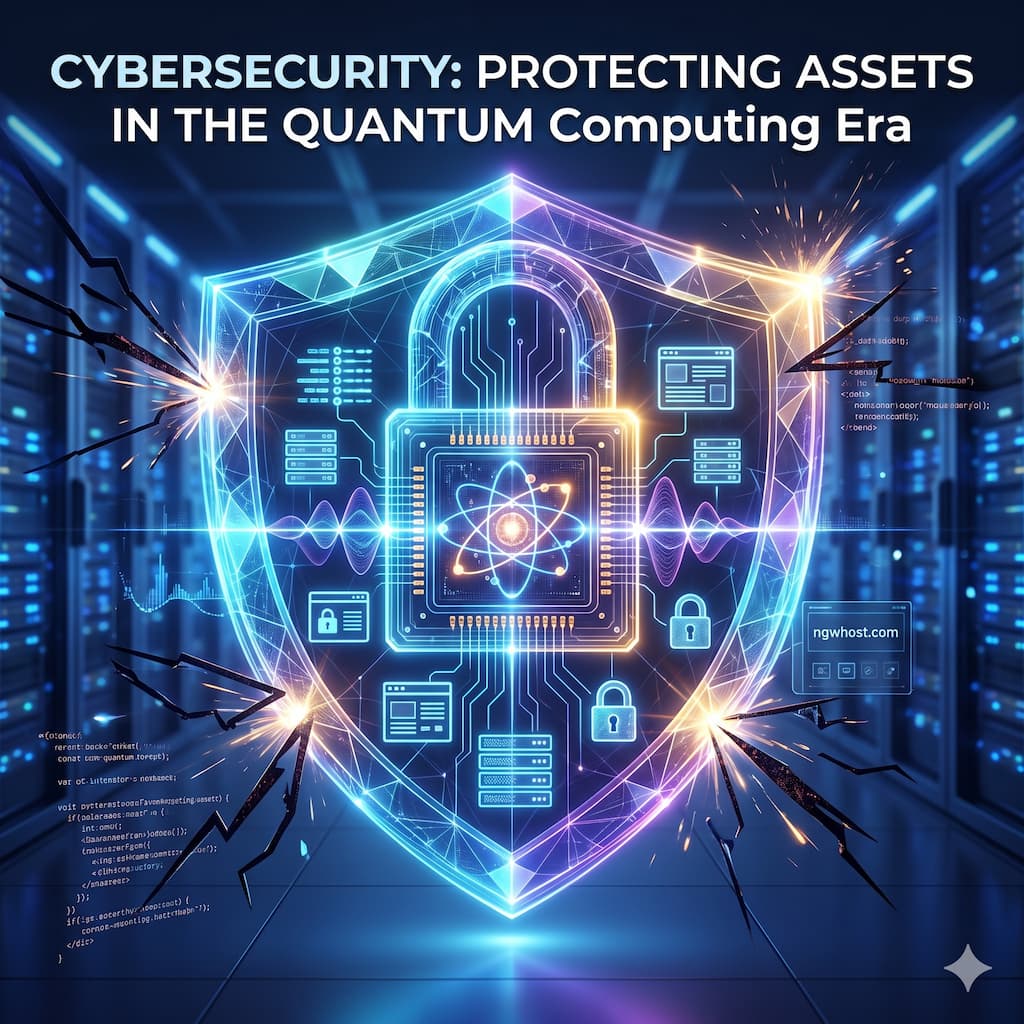
Cybersecurity: Protecting Assets in the Quantum Computing Era
The Quantum Horizon and “Q-Day”
In the history of digital technology, few advancements have been as anticipated and feared as the arrival of viable, large-scale quantum computing. For decades, the concept of a quantum computer was a theoretical pursuit restricted to high-level physics laboratories. Today, we are witnessing the dawn of the “Quantum Decade.” As industry giants and nation-states race to achieve quantum supremacy, the conversation is shifting from “if” to “when.”
For the digital ecosystem—ranging from web hosting infrastructures like ngwhost.com to the vast networks of global finance—this progress presents a paradox. Quantum computers promise to solve complex problems in materials science, medicine, and optimization that are currently unsolvable by classical computers. However, they also possess the inherent capability to dismantle the cryptographic foundations upon which the modern internet is built.
The moment a quantum computer becomes capable of breaking current encryption standards is widely referred to as “Q-Day.” For digital entrepreneurs, content managers, and systems administrators, protecting assets in this era requires more than just updated software; it requires a fundamental rethink of cryptographic agility and infrastructure resilience.
I. Understanding the Quantum Shift: Why Classical Rules No Longer Apply
To protect assets in the quantum era, one must first understand the fundamental difference between classical and quantum processing.
1. Bits vs. Qubits
Classical computing is binary, operating on bits that exist in a state of either 0 or 1. Every password, encrypted file, and server handshake is processed through this binary logic. Quantum computing, however, utilizes “qubits.” Thanks to the principles of quantum mechanics—specifically superposition and entanglement—a qubit can exist in multiple states simultaneously.
2. Parallelism and Processing Power
Superposition allows a quantum computer to explore a vast number of possibilities at once. While a classical computer must check every potential key to a digital lock sequentially, a quantum computer can evaluate millions of possibilities in parallel. This isn’t just a faster way of doing what we already do; it is an entirely different mathematical approach to processing information.
II. The Cryptographic Crisis: Why Current Standards Will Fail
The primary threat to cybersecurity lies in the fact that our modern security is based on “hard” mathematical problems. Current public-key encryption (asymmetric encryption) relies on the extreme difficulty of factoring large prime numbers or solving discrete logarithm problems.
1. Shor’s Algorithm: The RSA Killer
In 1994, mathematician Peter Shor developed an algorithm specifically designed for quantum computers. Shor’s Algorithm demonstrates that a sufficiently powerful quantum computer could factor large integers exponentially faster than any classical algorithm.
- RSA Encryption: Currently used for securing emails, web traffic (HTTPS), and digital signatures. A quantum computer could crack a 2048-bit RSA key in hours, a task that would take a classical supercomputer billions of years.
- Elliptic Curve Cryptography (ECC): Used widely in mobile devices and blockchain technology. ECC is even more vulnerable to quantum attacks than RSA, requiring fewer qubits to be broken.
2. Grover’s Algorithm and Symmetric Encryption
Symmetric encryption (like AES-256), used for data at rest, is more resilient than asymmetric encryption but is not immune. Grover’s Algorithm provides a quantum speedup for searching unstructured databases.
- The Impact: It essentially reduces the security of a symmetric key by half. This means an AES-128 key becomes as easy to crack as an AES-64 key. To maintain current security levels, businesses must transition to AES-256 or higher, which remains quantum-resistant for the foreseeable future.
III. “Store Now, Decrypt Later”: The Invisible Threat
A common misconception is that quantum threats only matter once the hardware is ready. This overlooks the “Store Now, Decrypt Later” (SNDL) strategy already being employed by malicious actors and foreign intelligence agencies.
Hackers are currently harvesting and storing encrypted sensitive data—government secrets, proprietary source code, and long-term financial records—waiting for the day they can use a quantum computer to unlock it. For businesses managing high-value digital assets, the damage is being done today. If your data must remain secret for the next ten to twenty years, classical encryption is already insufficient.
IV. Post-Quantum Cryptography (PQC): The New Defensive Wall
The global cybersecurity community is not standing still. The National Institute of Standards and Technology (NIST) in the United States has been leading a global effort to standardize Post-Quantum Cryptography (PQC)—algorithms designed to be secure against both quantum and classical computers.
1. Lattice-Based Cryptography
This is the most promising category of PQC. It involves hiding data within complex multidimensional geometric structures (lattices). Solving these problems remains computationally intensive even for quantum computers, as there is no known quantum algorithm that can “shortcut” the solution.
2. Code-Based and Multivariate Cryptography
These methods rely on the difficulty of decoding general linear codes or solving systems of multivariate quadratic equations. While they often require larger key sizes than current RSA or ECC, they provide a robust alternative for long-term asset protection.
3. Hash-Based Signatures
For securing software updates and digital signatures—critical for web hosting providers and developers—hash-based signatures offer a quantum-resistant method of verifying authenticity. They are well-understood and already being integrated into high-security environments.
V. Strategic Infrastructure Implementation for Web Services
For an infrastructure provider like ngwhost.com, protecting client assets in the quantum era involves a multi-layered transition of the entire server stack.
1. Crypto-Agility: The Core Requirement
The days of “set it and forget it” encryption are over. Infrastructure must be “crypto-agile.” This means the ability to swap out cryptographic algorithms without re-architecting the entire system.
- Action: Hosting environments must prepare to support hybrid key exchanges—combining a classical key (like ECDH) with a quantum-resistant key (like Kyber). This ensures that if one is broken, the other still provides protection.
2. Securing the Management Plane
Web administrators often manage their servers via tools like aaPanel or direct SSH. In a quantum era, the management plane is the highest-value target.
- Quantum-Resistant SSH: Transitioning to SSH implementations that utilize PQC algorithms for key exchange and authentication is vital to prevent unauthorized server-side access.
- API Security: For digital entrepreneurs using APIs to automate content across platforms like fgtd.online or SuperAchado, ensuring those API handshakes are quantum-resistant is essential to prevent “Man-in-the-Middle” (MitM) attacks.
3. Database and Data-at-Rest Encryption
Symmetric encryption remains relatively strong, but the migration to AES-256 must be accelerated. Furthermore, implementing “honey-encryption”—where a wrong key generates plausible but fake data—can further frustrate quantum-powered brute-force attempts.
VI. Quantum Key Distribution (QKD): The Physical Solution
While PQC focuses on new mathematical algorithms, Quantum Key Distribution (QKD) utilizes the laws of physics to secure communications.
QKD uses individual photons to exchange cryptographic keys. Because of the “Observer Effect” in quantum mechanics, any attempt to eavesdrop on the photon stream changes their state, alerting the sender and receiver to the breach.
- The Benefit: It provides “information-theoretic security,” which is mathematically unbreakable regardless of computing power.
- The Challenge: Currently, QKD requires specialized fiber-optic or satellite hardware, making it expensive and difficult to implement for general web hosting. However, for high-value enterprise assets and sensitive data transfers, it represents the ultimate shield.
VII. A Roadmap for Digital Asset Protection in 2026
For business owners and web developers, the transition to quantum readiness should follow a structured roadmap:
1. The Inventory Phase
Identify every instance where encryption is used in your business. This includes:
- SSL/TLS certificates for your domains.
- Encrypted databases and backups.
- Digital signatures for software or contracts.
- VPN and remote access tunnels.
2. Prioritizing Long-Shelf-Life Data
Identify which data has the longest “secrecy requirement.” Financial records, intellectual property, and personal identification data are the most vulnerable to SNDL attacks and should be the first candidates for PQC migration.
3. Adopting a Hybrid Approach
Do not jump solely to PQC immediately. Current PQC algorithms are still being battle-tested. The industry standard is a hybrid approach: encrypting data with both a classical algorithm (to protect against current threats) and a PQC algorithm (to protect against future quantum threats).
4. Partnering with Quantum-Ready Providers
The security of your assets is only as strong as the infrastructure they reside on. Digital entrepreneurs should prioritize hosting providers and SaaS platforms that demonstrate a clear commitment to quantum-safe standards and cryptographic agility.
Read More⚡ Cloud Hosting vs. VPS: Which is Best for Your Fintech Startup?
VIII. Conclusion: The Proactive Path to Resilience
The quantum computing era is not a distant science-fiction scenario; it is a fast-approaching reality that demands immediate strategic attention. While the threat to classical encryption is absolute, the tools for defense are already within our reach.
For platforms like ngwhost.com and the digital entrepreneurs who rely on them, the goal is to build resilience through awareness and agility. By transitioning to AES-256, implementing hybrid PQC/classical encryption, and maintaining a high level of “crypto-agility” in server management, businesses can ensure that their digital assets remain secure long after the first quantum computer goes online.
Cybersecurity in 2026 is no longer just about stopping the hackers of today; it is about out-innovating the technology of tomorrow. Those who act now to protect their assets in the quantum era will be the ones who lead the digital economy of the future.
For more technical deep dives on server security, digital infrastructure, and the evolution of the web, stay tuned to the ngwhost.com blog.