Cloud Hosting vs. VPS: Which is Best for Your Fintech Startup?
The Foundation of Financial Trust
In the high-stakes world of financial technology (fintech), your infrastructure is more than just the servers that run your code; it is the absolute foundation of your company’s trust, security, and potential for scale. When a user deposits money, trades a stock, or processes a payment, they expect instantaneous execution and military-grade security. A lag of three seconds can cause a user to abandon a transaction; a minute of downtime can cost thousands of dollars and trigger regulatory scrutiny; a data breach can end the company entirely.
For founders and Chief Technology Officers (CTOs) tasked with building the next generation of financial apps, choosing the right server architecture is one of the most consequential early decisions. The debate almost always narrows down to two heavyweights: Virtual Private Servers (VPS) and Cloud Hosting.
While both provide virtualized environments, their underlying architectures, cost models, scalability, and approaches to security are vastly different. Choosing the wrong one can lead to bloated budgets, crippling downtime during vital growth phases, or failed compliance audits.
This comprehensive guide, brought to you by ngwhost.com, will dissect the “Cloud Hosting vs. VPS” debate specifically through the lens of a fintech startup. We will analyze the technical differences, evaluate how each handles rigorous security and compliance demands, break down the financial implications, and provide clear scenarios to help you determine which infrastructure will power your financial revolution.
Part 1: Deconstructing the Architectures
Before we can compare their efficacy for fintech, we must define the fundamental architectural differences between a VPS and Cloud Hosting.
What is a Virtual Private Server (VPS)?
A Virtual Private Server (VPS) is created through a process called hypervisor virtualization. A single, massive physical server (the “bare metal” host) is partitioned into multiple smaller, isolated virtual servers.
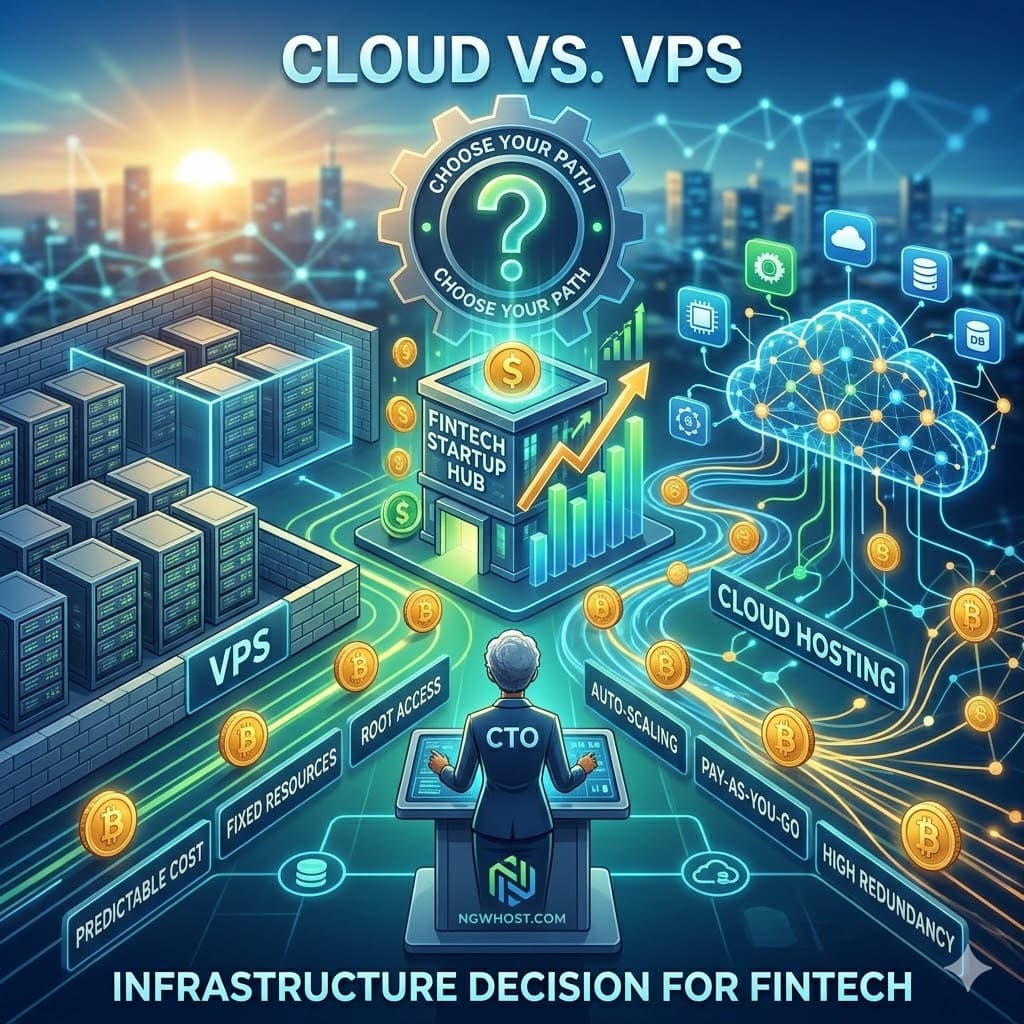
When you purchase a VPS, you are renting a specific, guaranteed slice of that physical server’s resources. If you pay for 8GB of RAM and 4 CPU cores, those resources are strictly allocated to you. You have root access, allowing you to choose your operating system (Ubuntu, CentOS, Debian) and configure your software stack (Nginx, Apache, specialized databases) exactly as you see fit.
The Fintech Perspective: A VPS offers a highly controlled, predictable environment. It behaves exactly like a dedicated server but at a fraction of the cost. However, because your VPS lives on one specific physical machine, you are subject to the hardware limitations and potential physical failures of that single host.
What is Cloud Hosting?
Cloud Hosting also utilizes virtualization, but it completely detaches the virtual server from any single piece of physical hardware. Instead of your server living on one machine, your data and computing resources are distributed across a vast, interconnected network of physical servers—often spanning multiple data centers or even geographic regions.
When you spin up a “Cloud Instance” (like an AWS EC2 instance, a Google Cloud Compute Engine, or DigitalOcean Droplet), you are tapping into a massive pool of clustered resources.
The Fintech Perspective: Cloud hosting is defined by its elasticity and redundancy. Because your environment isn’t tied to a single motherboard or hard drive, hardware failures are essentially invisible to your application; the cloud seamlessly shifts your instance to healthy hardware. Furthermore, it allows you to scale resources up or down dynamically based on real-time demand.
Part 2: Security and Compliance (The Fintech Non-Negotiables)
If you are building a social media app, a server breach is embarrassing. If you are building a fintech app, a server breach is catastrophic. Fintech startups must navigate a labyrinth of regulatory frameworks, including PCI-DSS (for credit card processing), GDPR/CCPA (for data privacy), and SOC 2 (for organizational security controls).
VPS Security: Total Isolation, Total Responsibility
A VPS provides a strong baseline of security through strict hypervisor isolation. Unlike cheap “Shared Hosting,” where a compromised neighboring website can infect your files, a VPS is walled off.
However, with a VPS, you operate under a model of total responsibility. The hosting provider secures the physical data center, but everything from the Operating System upward is your job. Your technical team must manually configure firewalls (like UFW or iptables), manage SSH keys, install intrusion detection systems (IDS), patch the OS for zero-day vulnerabilities, and manually encrypt databases at rest.
For compliance, achieving PCI-DSS on a standard VPS can be exceptionally difficult. Auditors will require you to prove the physical security of the host machine and demonstrate complex network isolation that is often challenging to achieve on a single partitioned server.
Cloud Security: Enterprise-Grade Fences and Shared Responsibility
Cloud platforms operate on a “Shared Responsibility Model.” The cloud provider assumes responsibility for the security of the cloud (physical facilities, networking hardware, hypervisors), while you are responsible for security in the cloud (your code, your data, your access policies).
For fintech, Cloud Hosting offers massive advantages:
- Pre-Certified Infrastructure: Major cloud providers (AWS, Azure, GCP) undergo rigorous, continuous third-party audits. Their underlying infrastructure is already certified for PCI-DSS, HIPAA, and SOC 2. While you still have to secure your own app, building on top of pre-certified infrastructure makes passing your own audits exponentially easier and cheaper.
- Advanced Security Tooling: Cloud platforms offer integrated, enterprise-grade security tools out of the box. This includes Web Application Firewalls (WAF), automated DDoS mitigation, granular Identity and Access Management (IAM) roles, and automated Key Management Services (KMS) for data encryption.
- Dedicated Hosts: If a regulator explicitly forbids multitenancy (sharing hardware with other companies), cloud providers offer “Dedicated Instances”—giving you the elasticity of the cloud but isolated on physical hardware dedicated solely to your startup.
The Verdict for Fintech Security: While a well-configured VPS is secure, Cloud Hosting wins decisively. The access to enterprise-grade security tools and the massive head start on regulatory compliance are invaluable for financial startups.
Part 3: Scalability and Performance (Handling the Viral Spike)
Fintech growth is rarely linear. A mention in a major financial publication, a viral marketing campaign, or a sudden change in macroeconomic conditions (like a crypto bull run) can cause traffic to spike by 10,000% overnight. Your infrastructure must survive these events.
VPS: The Ceiling of Vertical Scaling
Scaling a VPS is primarily a “vertical” process. If your trading platform is running out of memory, you must upgrade your server plan to one with more RAM and CPU.
There are two major problems with this for fintech:
- Downtime: Upgrading a VPS almost always requires a system reboot. If the market is crashing and your users are desperately trying to log in to sell assets, taking the server offline for 10 minutes to upgrade the RAM is unacceptable.
- The Physical Limit: You can only scale a VPS as high as the physical limits of the host machine it resides on. Once you max out the host, migrating to a new machine is a complex, manual, and risky process.
Cloud Hosting: Infinite Horizontal Elasticity
Cloud hosting was built for volatility. It allows for both vertical scaling (resizing instances instantly) and, more importantly, horizontal scaling.
Instead of relying on one massive server, you can configure Auto-Scaling Groups. If your CPU utilization hits 80% during a traffic spike, the cloud will automatically clone your server, spin up two more instances, and distribute the traffic across them using a Load Balancer. When the traffic subsides at night, the cloud automatically destroys the extra instances to save money.
This ensures that your users experience zero lag during peak trading hours, and your application never goes offline due to resource exhaustion.
The Verdict for Scalability: Cloud Hosting is the undisputed champion. The ability to scale horizontally and automatically is a mandatory requirement for any high-growth consumer fintech application.
Part 4: Reliability and Disaster Recovery
In financial services, high availability (HA) is critical. Users need access to their funds 24/7/365.
The VPS Single Point of Failure
A standard VPS represents a Single Point of Failure (SPOF). If the motherboard on your host machine burns out, or the specific rack in the data center loses power, your fintech app goes offline. You are entirely dependent on the backup protocols you manually established. If you haven’t set up off-site replication, a hardware failure could result in permanent data loss—an extinction-level event for a financial company.
Cloud Redundancy and Multi-Region Deployments
Cloud infrastructure is inherently redundant. Data is often mirrored across multiple physical drives. If a piece of hardware fails, the cloud orchestrator instantly moves your virtual machine to healthy hardware.
Furthermore, cloud platforms allow for simple Multi-Availability Zone (Multi-AZ) and Multi-Region deployments. You can run your primary application in a data center in New York, with a real-time replica running in a data center in London. If the entire New York data center is hit by a natural disaster, your global traffic automatically reroutes to London. Your users won’t even know there was an issue.
The Verdict for Reliability: Cloud Hosting is vastly superior for disaster recovery and ensuring the 99.999% (“five nines”) uptime expected in the financial industry.
Part 5: Cost Management (Bootstrapped vs. Funded)
If Cloud Hosting is so vastly superior in scalability, security, and reliability, why does anyone use a VPS? The answer almost always comes down to cost and complexity.
The Predictability of VPS
A VPS operates on a flat-rate billing model. If you buy a plan for $40 a month, you pay exactly $40 a month. Regardless of whether your server sits idle or runs at 100% CPU capacity 24/7, your bill remains identical.
For a bootstrapped fintech startup—perhaps building an MVP (Minimum Viable Product), a B2B financial tool with predictable traffic, or an internal dashboard—this financial predictability is a massive advantage. You don’t need to worry about a sudden spike in traffic causing a massive, unexpected server bill. Furthermore, bandwidth (data egress) is typically heavily subsidized or unmetered on VPS plans.
The Double-Edged Sword of Cloud Pricing
Cloud computing utilizes a “Pay-as-You-Go” utility model. You pay by the minute or the second for exact compute cycles, RAM usage, and, crucially, data egress (the bandwidth leaving the cloud).
While this is incredibly efficient—you don’t pay for what you don’t use—it can be incredibly dangerous for early-stage startups without dedicated DevOps engineers. If your code has a bug that causes it to loop infinitely, or if you are hit by a prolonged DDoS attack, your cloud infrastructure will automatically scale to handle it. While your app will stay online, you could wake up to an infrastructure bill of tens of thousands of dollars.
Furthermore, major cloud providers (AWS, GCP) charge a premium for their managed services and outgoing bandwidth, making the baseline cost significantly higher than an equivalent VPS.
The Verdict for Cost: VPS wins on predictability and raw cost-efficiency for early-stage development. Cloud Hosting is better for aligning costs directly with revenue-generating traffic, provided you have the engineering talent to monitor and optimize the architecture.
Part 6: Making the Decision (Use Cases for Fintech)
To finalize your decision, you must match the infrastructure to your company’s current stage and specific business model.
Scenario A: The Bootstrapped B2B SaaS
Profile: You are building a B2B accounting integration tool or an internal financial analytics dashboard. You have a small, predictable number of users. You are self-funded and managing your runway tightly. You have a developer who knows their way around a Linux terminal (managing tools like aaPanel, resolving DNS, and tweaking configuration files manually). The Recommendation: VPS. A robust VPS will give you the raw horsepower you need at a highly predictable, low cost. Since your traffic doesn’t experience viral consumer spikes, you don’t need the expensive auto-scaling features of the cloud. You can invest the money saved on infrastructure directly into product development.
Scenario B: The Funded Consumer Neobank or Trading App
Profile: You have secured seed or Series A funding. You are launching a consumer-facing app (like a retail investing platform, a crypto exchange, or a peer-to-peer payment app). You anticipate sudden spikes in traffic during market events. You will be holding user funds and require strict PCI-DSS compliance. The Recommendation: Cloud Hosting. You cannot afford downtime, and you cannot risk a failed compliance audit. The auto-scaling capabilities, multi-region redundancy, and pre-certified compliance frameworks of a major cloud provider are not just luxuries; they are mandatory requirements for your business model to survive and pass due diligence from institutional partners.
Scenario C: The High-Frequency Trading (HFT) Algorithm
Profile: You are building proprietary algorithms that execute trades in milliseconds. Latency is the only metric that matters. The Recommendation: Bare Metal / Dedicated Cloud. Neither a standard VPS nor a standard Cloud VM is sufficient. You need “Bare Metal” servers located in the exact same physical data center as the financial exchange you are trading on to eliminate network latency.
Read More⚡ The 5 Best Platforms for Safe Crypto Staking in 2026
Conclusion: Engineering for the Future
Building a fintech startup is an exercise in managing risk. Financial risk, regulatory risk, and technical risk.
For the vast majority of ambitious, growth-oriented fintech startups handling sensitive financial data and expecting volatile traffic patterns, Cloud Hosting is the definitive answer. The higher upfront complexity and variable costs are an insurance policy against the catastrophic consequences of downtime and security breaches in the financial sector.
However, if you are in the very early stages of bootstrapping a predictable, low-volume financial tool, a high-quality VPS remains a powerful, cost-effective way to get your Minimum Viable Product to market without burning through your capital.
Whichever path you choose, ensure that your infrastructure is built with security as the absolute foundation. In fintech, technology can be replicated, but user trust, once lost, is gone forever.
For more expert insights on server management, hosting architecture, and optimizing your digital infrastructure, explore the resources at ngwhost.com.