The 5 Best Platforms for Safe Crypto Staking in 2026
The Maturation of the Crypto Yield Market
As we progress through 2026, the cryptocurrency landscape has fundamentally shifted. The days of wild, unsustainable triple-digit APYs (Annual Percentage Yields) and the reckless algorithmic experiments that defined the early 2020s are largely behind us. Following the institutional adoption catalyzed by spot ETFs and sweeping regulatory frameworks across major global jurisdictions, the digital asset market has matured into a legitimate, infrastructure-driven financial ecosystem.
For long-term investors, traders, and technologists, holding digital assets idle in a wallet is no longer the standard play. Proof-of-Stake (PoS) networks—led by the dominance of Ethereum, alongside robust alternatives like Solana, Polkadot, and Cardano—have made staking the baseline strategy for generating passive income. By participating in network validation, investors can earn consistent, compounded yields on their holdings.
However, the most critical metric in 2026 is no longer just the highest yield; it is security. The collapse of over-leveraged centralized lenders in past market cycles served as a permanent lesson: “Not your keys, not your coins” and “If you don’t know where the yield comes from, you are the yield.”
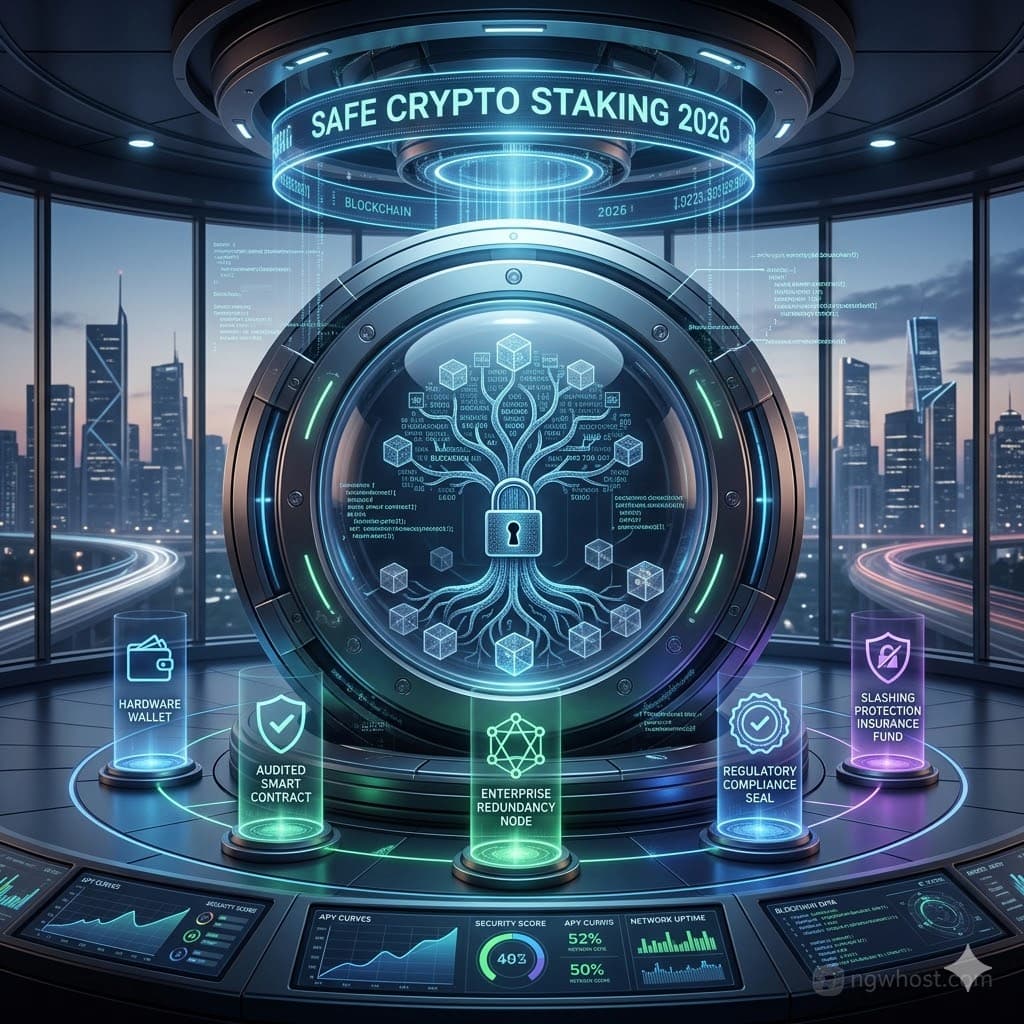
Today, safe staking requires platforms that offer transparent on-chain proof of reserves, rigorous smart contract audits, hardware-level security integrations, and comprehensive slashing protection. In this deep dive for ngwhost.com, we will explore the definitive list of the five best, most secure platforms for crypto staking in 2026, breaking down their infrastructure, their pros and cons, and why they deserve your trust.
Understanding Staking Safety in 2026: What Makes a Platform “Safe”?
Before diving into the top platforms, it is essential to define what “safety” actually means in the context of the 2026 crypto economy. Staking is inherently different from lending. When you lend crypto, you are trusting a third party to generate returns through trading or issuing loans. When you stake, you are directly locking your assets into a blockchain’s consensus mechanism to secure the network.
To evaluate the safety of a staking platform, we must look at three primary risk vectors:
- Custodial Risk (Centralized Platforms): If a platform holds your private keys, what happens if the company goes bankrupt or suffers an internal hack? Safe centralized platforms in 2026 must boast 1:1 backed Proof of Reserves (PoR), utilize institutional-grade cold storage, and operate within strict regulatory compliance.
- Smart Contract Risk (Decentralized Platforms): If you are using decentralized finance (DeFi) protocols, the code is the law. Safe decentralized platforms must have continuous, multi-firm security audits, active bug bounty programs, and open-source infrastructure that has been battle-tested by billions of dollars in Total Value Locked (TVL) over several years.
- Slashing Risk: In PoS networks, validators can be penalized (slashed) for malicious behavior or prolonged downtime, resulting in a loss of staked funds. Top-tier platforms mitigate this by running highly redundant, enterprise-grade server infrastructures across diverse geographic regions to guarantee near 100% uptime, and they often provide insurance funds to cover any potential slashing events.
With these rigorous criteria in mind, here are the top 5 platforms for secure crypto staking.
1. Ledger Live: The Gold Standard for Self-Custody and Security
When discussing absolute safety in cryptocurrency, the conversation must begin with hardware wallets, and Ledger remains the undisputed titan of self-custody in 2026. Ledger Live is the companion software interface for Ledger hardware devices (such as the Nano X or Ledger Stax), and it has evolved into a comprehensive, highly secure staking hub.
How it Works: Ledger Live does not act as a centralized exchange or a custodian. Instead, it serves as a secure bridge, allowing you to interact with native blockchain staking contracts and top-tier validation services (like Kiln, Lido, or native node operators) directly from your cold wallet.
Why it is Safe: The fundamental advantage of Ledger Live is that your private keys never leave your physical device. Even while your assets are actively staked and generating yield on the blockchain, the cryptographic keys required to un-stake or move those funds remain offline, totally isolated from internet-connected malware or exchange bankruptcies.
Best For: Ledger Live is the ultimate choice for security-conscious investors, long-term holders, and those who adhere strictly to the “not your keys, not your coins” ethos. It supports native staking for networks like Polkadot, Solana, Cardano, and Cosmos, as well as Ethereum liquid staking. If you are managing significant capital, hardware-secured staking is the only truly foolproof method against centralized failures.
2. Coinbase: The Institutional and Regulatory Benchmark
For users who prefer the convenience of a centralized platform and do not want to manage their own private keys or hardware devices, Coinbase is arguably the safest Centralized Exchange (CEX) on the planet. As a publicly traded company in the United States, Coinbase operates under the most intense regulatory scrutiny of any crypto entity.
How it Works: Coinbase offers a frictionless staking experience. Users simply deposit their supported assets (such as ETH, SOL, ADA, or MATIC) and toggle the staking option. The exchange handles all the complex backend infrastructure, pooling user funds, spinning up validator nodes, and automatically compounding the rewards for a percentage fee. Furthermore, Coinbase offers Liquid Staking Tokens (LSTs) like cbETH, allowing users to earn Ethereum staking rewards while retaining a tradable token that can be sold or used in DeFi.
Why it is Safe: Coinbase’s security architecture is institutional-grade. They utilize Multi-Party Computation (MPC), heavily guarded cold storage for the vast majority of assets, and rigorous internal access controls. Crucially, Coinbase guarantees the principal of staked assets against slashing penalties. If one of Coinbase’s validator nodes suffers a technical failure and is penalized by the blockchain, Coinbase absorbs the loss out of its corporate treasury, ensuring the user’s funds are never impacted.
Best For: Beginners, institutional investors, and users who prioritize ease-of-use and regulatory compliance over maximizing every single basis point of yield. The fees on Coinbase staking are higher than decentralized alternatives, but you are paying a premium for peace of mind, audited financial statements, and a world-class security team.
3. Lido Finance: The Battle-Tested Behemoth of Liquid Staking
Lido Finance fundamentally changed the mechanics of Ethereum staking and remains the undisputed king of Decentralized Finance (DeFi) liquid staking in 2026. While it operates differently than a centralized exchange, its immense scale and battle-tested code make it a highly secure option for DeFi participants.
How it Works: Traditionally, staking Ethereum required locking up 32 ETH and running complex validator software. Lido democratized this process. Users deposit any amount of ETH into Lido’s smart contracts. In return, Lido issues stETH (Staked ETH), a liquid token representing the deposited ETH plus the accumulated staking rewards. Users can hold stETH to passively earn yield, or they can use it across the broader DeFi ecosystem as collateral for lending or liquidity provision.
Why it is Safe: Lido’s safety lies in its decentralization and transparency. When you deposit ETH into Lido, it is distributed across a curated set of professional, highly vetted, and geographically distributed Node Operators. This prevents a single point of failure. Furthermore, Lido’s smart contracts are entirely open-source and have undergone dozens of independent security audits by the most respected firms in the industry. With billions of dollars in Total Value Locked (TVL) safely managed over several years without a critical failure, Lido’s code is considered some of the most robust in Web3.
Best For: Intermediate to advanced users who want to stake Ethereum without locking up their liquidity, and those who want to participate in the broader DeFi ecosystem while still earning base-layer network yields.
4. Rocket Pool: The Champion of True Decentralization
While Lido dominates the market share of liquid staking, Rocket Pool is widely revered by blockchain purists and security experts as the gold standard for true, permissionless decentralization. In 2026, as concerns over network centralization continue to influence the market, Rocket Pool’s architecture offers a highly secure and philosophically aligned staking method.
How it Works: Similar to Lido, users can deposit ETH into Rocket Pool and receive rETH, a liquid staking token that accrues value over time as the network generates rewards. However, the backend architecture is entirely different. Instead of relying on a permissioned, hand-picked set of professional node operators, Rocket Pool allows anyone to become a node operator by putting up a smaller bond (originally 16 ETH, and increasingly smaller through updates) combined with RPL token collateral.
Why it is Safe: Rocket Pool’s security is derived from its trustless design and heavy over-collateralization. Because node operators must lock up their own capital (ETH and RPL tokens) alongside user deposits, they have massive financial “skin in the game” to maintain their nodes perfectly and avoid slashing penalties. If an operator performs poorly and is slashed, their bonded capital is penalized first, protecting the deposited funds of the average rETH holder. Furthermore, the protocol is heavily decentralized, reducing the risk of regulatory capture or coordinated attacks.
Best For: Users who prioritize network decentralization, Ethereum purists, and advanced users looking to run their own “minipool” nodes for higher yields. Holding rETH is an exceptionally safe way to gain exposure to Ethereum staking rewards while supporting the health and distribution of the underlying blockchain.
5. Kraken: The Veteran Powerhouse (International Markets)
Kraken is one of the oldest, most resilient cryptocurrency exchanges in the world. Founded in 2011, it has survived every major bear market and industry collapse through conservative financial management and an obsessive focus on cybersecurity. While regulatory shifts in the US forced changes to its American staking programs, Kraken remains a top-tier, ultra-secure staking destination for the international market in 2026.
How it Works: Kraken offers a highly intuitive “Earn” dashboard where users can stake a wide variety of assets, from major layer-1 protocols to smaller, high-yield altcoins. Staking rewards are accrued and paid out on a regular schedule (often weekly or bi-weekly), and the un-staking process is typically seamless, depending on the specific blockchain’s bonding periods.
Why it is Safe: Kraken’s security reputation is legendary in the crypto space. They employ comprehensive physical security for their server locations, utilize air-gapped cold storage for the overwhelming majority of client assets, and have a dedicated internal team (Kraken Security Labs) that constantly audits both their own systems and the broader crypto ecosystem. Kraken regularly publishes cryptographically verified Proof of Reserves, allowing users to independently verify that their assets are fully backed. Like Coinbase, they utilize enterprise-grade infrastructure to run their validator nodes, practically eliminating the risk of slashing for the end-user.
Best For: International users looking for a wide variety of stakable assets beyond just Ethereum and Bitcoin, who want the convenience of a centralized exchange backed by a flawless decade-long security track record.
Centralized vs. Decentralized: Making the Right Choice
When choosing a platform from this list, the primary decision boils down to your comfort level with custody.
Centralized Platforms (Coinbase, Kraken) abstract away all the technical complexities. You do not need to worry about managing seed phrases, paying fluctuating gas fees for smart contract interactions, or understanding liquid token dynamics. However, you must trust the corporation’s internal security and regulatory standing.
Decentralized Platforms and Hardware Wallets (Lido, Rocket Pool, Ledger Live) offer total autonomy. You are trusting public, auditable mathematics (smart contracts) and your own ability to secure your private keys. While the learning curve is steeper, the elimination of counterparty risk—the risk that a company goes bankrupt with your funds—makes this the preferred route for high-net-worth investors and tech-savvy individuals.
Read More⚡ Understanding the Impact of Global Inflation on Personal Finances
Conclusion: Securing Your Financial Future
As the digital economy matures in 2026, staking has transformed from a niche technical experiment into a foundational pillar of modern asset management. However, the pursuit of yield must never supersede the preservation of capital.
The platforms highlighted above—Ledger Live, Coinbase, Lido, Rocket Pool, and Kraken—represent the pinnacle of staking security. They employ diverse strategies, ranging from hardware isolation and institutional compliance to decentralized over-collateralization and open-source transparency.
For the readers of ngwhost.com, who understand the importance of robust infrastructure and secure data management, the approach to crypto should be no different. The best strategy is often diversification: holding long-term foundational assets in cold storage via Ledger, utilizing liquid staking protocols like Rocket Pool for DeFi utility, and keeping a portion on highly regulated exchanges like Coinbase for immediate liquidity. By prioritizing security first, you ensure that your portfolio continues to generate reliable, compounded yields well into the future.