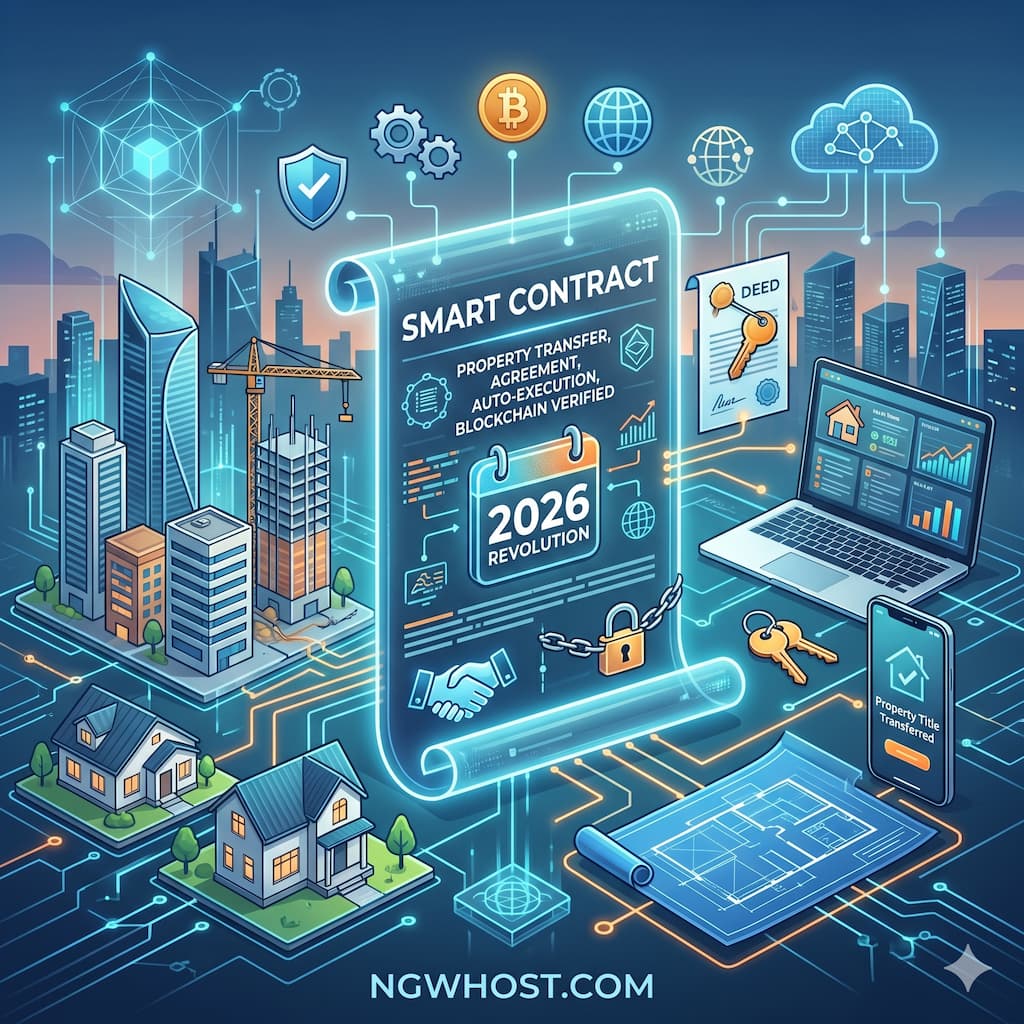
Smart Contracts in Real Estate: The 2026 Revolution
The real estate industry is notoriously slow, paper-heavy, and plagued by intermediaries. For decades, buying a property meant dealing with a mountain of bureaucracy: title companies, escrow agents, lawyers, brokers, and endless waiting periods.
But as we cruise through May 2026, a quiet yet unstoppable infrastructure shift has crossed the chasm from experimental tech to mainstream adoption. Smart Contracts—self-executing digital agreements permanently coded on a blockchain—have officially triggered a real estate revolution.
For the tech-forward developers, digital entrepreneurs, and infrastructure managers reading ngwhost.com, this trend represents a massive convergence of physical assets and digital automation. The global real estate tokenization market alone has surged past $26 billion in 2026, with projections from institutional reports eyeing a run toward the hundreds of billions by the end of the year.
This comprehensive guide explores how smart contracts are completely re-architecting property transactions, fractionalizing ownership, automating leasing, and how you can position your digital operations to ride this multi-trillion-dollar structural wave.
1. What is a Real Estate Smart Contract?
At its core, a smart contract is a protocol designed to digitally facilitate, verify, or enforce the performance of a contract without human intermediaries.
Instead of trusting a third-party escrow agent to hold a buyer’s down payment while waiting for a seller to sign a deed transfer, the rules of the transaction are written in immutable code (typically using languages like Solidity on Ethereum or alternative high-throughput Layer 2 networks).
The Conditional Execution Logic
The magic of a smart contract lies in its strict execution logic:
$$\text{If Clause } A \text{ (Financing Verified)} + \text{Clause } B \text{ (Title Cleared)} \rightarrow \text{Execute Action } C \text{ (Transfer Funds \& Ownership)}$$
In 2026, these contracts aren’t operating in a digital vacuum. They are deeply integrated with legal frameworks, real-world banking APIs, and national property registries. When the conditional parameters are met, the software executes the transaction instantly, updating the deed registry, moving the funds, and filing the tax declarations simultaneously.
2. The 2026 Paradigm Shift: Closing Deals While You Sleep
In traditional real estate, the most grueling part of the journey isn’t finding the property or negotiating the price—it’s the coordination. According to data from major real estate networks like REMAX Europe, the average time to close a standard residential property deal historically hovered between 30 and 60 days.
In 2026, smart contracts have compressed that timeline from weeks to seconds.
Eliminating the Friction Chokepoints
The 2026 smart contract framework solves the three fundamental friction chokepoints of the legacy property industry:
- Instant Escrow: No more wire transfer delays or exorbitant bank escrow fees. Digital escrow protocols hold the buyer’s stablecoins (like USDC or regulated institutional tokenized deposits) natively. The moment the corresponding title deed is digitally signed and released, the funds deploy to the seller with zero latency.
- Automated Title and Lien Verification: Blockchain asset registries provide a tamper-proof ledger of property histories. Cryptographic hashing creates a secure chain of custody, allowing smart contracts to pull history data instantly and verify that a property is free of hidden liens or structural ownership disputes.
- Cross-Border Fluidity: International buyers can acquire fractional or whole properties without needing a local bank account, physical notary appointments, or navigating complex cross-border remittance limits.
3. Real Estate Tokenization: The Rise of Fractional Wealth
You cannot discuss the 2026 smart contract revolution without focusing on its most explosive application: Real Estate Tokenization.
Tokenization means taking the ownership rights of a physical property—whether it’s a luxury apartment in Miami, a commercial warehouse in Germany, or an industrial data center—and dividing it into thousands of digital tokens recorded on a blockchain (such as the ERC-20 or ERC-1155 standards).
The Democratization of Capital
Historically, high-yield commercial real estate was an elite asset class requiring millions of dollars in upfront capital. Tokenization completely demolishes this barrier to entry.
- Low Minimum Thresholds: Investors can now purchase a fractional share of a premium commercial building for as little as $50 or $100.
- True Global Liquidity: Traditional real estate is highly illiquid; selling a building can take months. In 2026, real estate tokens can be traded 24/7 on specialized compliance platforms, decentralized exchanges (DEXs), or peer-to-peer (P2P) secondary markets. If an investor needs liquidity on a Tuesday morning, they can sell 15% of their property tokens in seconds.
The Institutional Reality
This is no longer a speculative Web3 playground. Institutional titans like BlackRock, J.P. Morgan, and Nasdaq are actively running production-grade on-chain asset tokenization layers. J.P. Morgan’s recent rollout of tokenized liquidity suites on public blockchains proves that the financial pipes of the real economy have permanently migrated to decentralized ledgers.
4. Automated Property Management & Intelligent Leasing
Beyond buying and selling, smart contracts are revolutionizing how properties are managed and operated day-to-day.
Smart Lease Agreements
In 2026, signing a lease no longer requires printing out 20-page documents or chasing down tenants for physical checks.
- Automated Rent Collection: A smart contract lease connects directly to the tenant’s digital wallet. On the first of the month, the rent is automatically pulled and deposited into the landlord’s account in stablecoins.
- Micro-Dispute Resolution: If a payment bounces or is delayed, the smart contract can trigger autonomous operational parameters—such as automatically applying a pre-agreed late fee or, in highly advanced smart buildings, updating digital lock permissions until the balance is cleared.
IoT Integration and Smart Buildings
Across Europe and North America, smart contracts are fusing with the Internet of Things (IoT) and the EU’s Smart Readiness Indicator (SRI) frameworks.
┌────────────────────────────────────────────────────────┐
│             THE AUTONOMOUS MAINTENANCE LOOP            │
└───────────────────────────┬────────────────────────────┘
                            │
                            ▼
┌────────────────────────────────────────────────────────┐
│ IoT Sensor Detects HVAC Component Wear                 │
└───────────────────────────┬────────────────────────────┘
                            │
                            ▼
┌────────────────────────────────────────────────────────┐
│ Smart Contract Queries Verified Vendor Registry        │
└───────────────────────────┬────────────────────────────┘
                            │
                            ▼
┌────────────────────────────────────────────────────────┐
│ Escrow Funds Released Autonomously Upon Digital Sign-Off│
└────────────────────────────────────────────────────────┘
When an IoT sensor in a smart building detects that an HVAC unit or elevator requires maintenance, it communicates directly with a property management smart contract. The contract autonomously checks a registry of verified technicians, requests a service call, locks in a price, and releases escrowed maintenance funds the moment the technician uploads a digital verification cryptographically signed by the building’s maintenance terminal.
5. Comparative Analysis: Traditional vs. Smart Contract Real Estate
To visualize the sheer scale of this efficiency upgrade, let us evaluate how a standard commercial property transaction splits across the old and new worlds in mid-2026:
| Transaction Feature | Legacy Real Estate Framework | 2026 Smart Contract Ecosystem |
| Average Settlement Time | 30 to 60 Days | Sub-Minute / Near Instantaneous |
| Intermediary Costs | 5% to 10% (Brokers, Notaries, Title Co.) | 0.5% to 2% (Platform / Gas Fees) |
| Minimum Investment | $50,000 – $250,000+ (Down payments) | $50 – $100 (Fractional Tokens) |
| Trading Hours | Mon-Fri, Local Banking Hours Only | 24/7/365 Global Liquidity |
| Record Security | Vulnerable Paper Records & Fragmented Databases | Immutable, Cryptographically Hashed Ledger |
| Accounting & Reporting | Manual monthly spreadsheets | Real-time automated programmatic distributions |
6. Real Obstacles Facing the 2026 Revolution
Despite the massive technical green lights, scaling smart contracts in real estate requires navigating real-world friction. This isn’t a frictionless utopia; it’s a structural transition.
Regulatory and Legal Variation
The largest roadblock in 2026 remains the lack of worldwide regulatory uniformity.
- The US Dilemma: The SEC largely classifies real estate tokens as security tokens, subjecting them to strict Security Token Offering (STO) frameworks, accredited investor constraints, and detailed KYC/AML (Know Your Customer / Anti-Money Laundering) checks.
- The Global Split: Jurisdictions that develop flexible, clear frameworks for digital deeds are seeing a massive influx of global real estate capital, while regions bound by old paper-based notarization mandates are experiencing capital flight.
The Code-to-Physical Gap
A smart contract is exceptional at moving digital value and titles, but it cannot fix a physical roof leak or settle a property line dispute with a neighbor. If a physical property damages or burns down, the underlying tokens face immediate valuation compression.
Therefore, tokenization platforms must deploy extensive capital into Asset Valuation, Ongoing Insurance Underwriting, and Professional Property Management Layers to ensure that the digital token always accurately reflects physical reality.
7. Implementation Blueprint for ngwhost.com Readers
For the digital administrators, real estate developers, and platform innovators looking to build or integrate into this space, here is your 2026 technical roadmap:
Step 1: Clean the Legal Entity
You cannot simply code a building onto a blockchain. You must wrap the physical property inside a compliant legal structure—typically a Special Purpose Vehicle (SPV), an LLC, or a specialized property trust. The smart contract then tokenizes the shares of that legal entity, ensuring that token ownership is legally enforceable in a court of law.
Step 2: Choose the Right Tokenization Stack
Don’t build your smart contracts from scratch unless you have a multi-million dollar security budget. Leverage turn-key, institutional-grade tokenization platform architectures (like Tokeny, SolidBlock, or RealT). Ensure your platform integrates robust KYC/AML modules to verify investor identities automatically before allowing access to the smart contract ledger.
Step 3: Architect for Multi-Chain Scalability
In May 2026, gas fee volatility on primary base layers can kill transaction efficiency. Build your real estate applications using high-speed Layer 2 protocols or multi-chain frameworks that ensure transferring a property token costs fractions of a cent, maintaining the low-cost competitive advantage of the digital model.
Read More⚡ Neobanks vs. Traditional Banks: The 2026 Verdict
Conclusion: The New Baseline of Property Scale
The smart contract revolution of 2026 has permanently shattered the legacy assumption that real estate must be slow, expensive, and exclusive. By shifting property ownership from clunky physical paper deeds to immutable, self-executing code, the industry has unlocked unprecedented global liquidity, democratized wealth building, and automated the administrative burden of property management.
For the community at ngwhost.com, the takeaway is undeniable: the tokenization of the real economy is here to stay. Whether you are an investor looking to diversify into fractional blue-carbon properties, a web administrator managing high-performance hosting for tokenized storefronts, or a developer funding construction projects via security token offerings—understanding and leveraging smart contracts is your gateway to scaling wealth at machine speed.
The bricks of the world are being re-coded into clicks. Is your portfolio running on the new software?