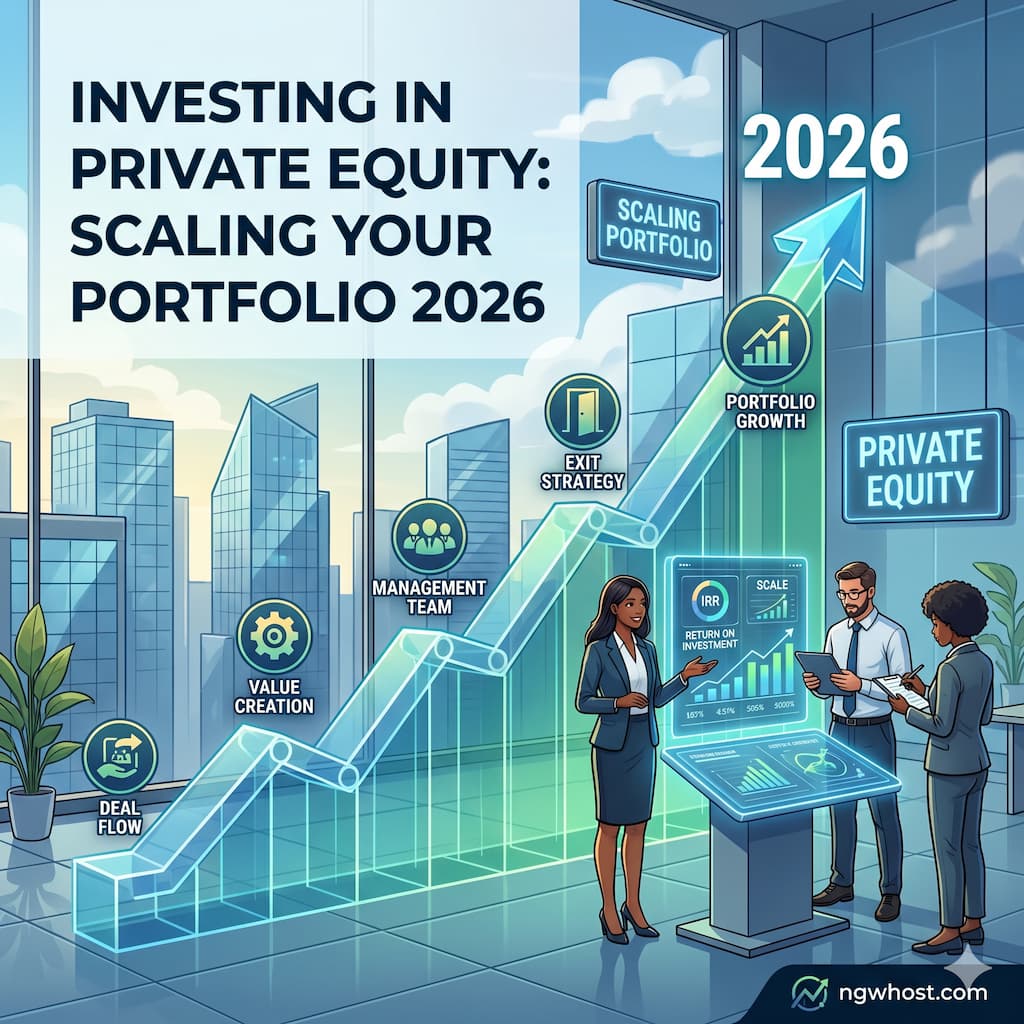
Investing in Private Equity: Scaling Your Portfolio 2026
The global investment playbook has been completely rewritten. As we move through May 2026, traditional public equity markets are grappling with compressed margins, regulatory gridlocks, and a structural trend toward consolidation. For sophisticated investors, family offices, and high-net-worth digital entrepreneurs within the ngwhost.com community, generating outsized alpha no longer happens by simply tracking the S&P 500 or purchasing liquid tech stocks.
The real engine of wealth creation has shifted decisively to the private markets. Private Equity (PE)—once an opaque playground reserved exclusively for billion-dollar institutional funds and sovereign wealth structures—has entered a new era of democratization, structural evolution, and digital integration.
In this comprehensive 2026 guide, we will dissect the current macroeconomic forces driving private equity performance, map out the sectors poised for exponential growth, evaluate the changing regulatory frameworks, and provide a tactical blueprint on how to scale your portfolio with private assets this year.
1. The 2026 Macro Environment: Private Equity’s Great Rotation
To successfully scale a portfolio using Private Equity in 2026, one must first dismantle the outdated investment assumptions of the early 2020s. The macro landscape has stabilized into a “new normal” characterized by steady terminal interest rates, sticky structural inflation, and a major capital reallocation away from overvalued public tech monopolies.
The “Stay Private Longer” Structural Paradigm
The relationship between public and private companies has fundamentally altered. In 2026, high-growth, mid-market enterprises are actively choosing to delay initial public offerings (IPOs) for as long as possible. The compliance burdens, quarterly earnings pressures, and short-term market scrutiny associated with being a public company have made private ownership far more attractive for executive teams focused on long-term structural scaling.
Consequently, the vast majority of a company’s valuation growth now occurs before it ever touches a public stock exchange. If you are only buying public equities, you are effectively buying mature assets at premium valuations, missing out on the explosive multi-bagger growth phases that occur purely within the private domain.
Institutional Capital Trends
Institutional allocators have recognized this shift. According to mid-year 2026 global asset management reports, institutional portfolios have expanded their target private market allocations to an all-time high of 22% to 26%. This massive influx of capital is driving unparalleled liquidity and transaction sophistication within the private mid-market ecosystem, creating an exceptional environment for secondary market buyers and co-investors looking to scale their portfolios efficiently.
2. The Core Pillars of Private Equity in 2026
Private Equity is not a monolith. To scale your portfolio strategically, you must understand how different PE sub-asset classes perform in the 2026 economic landscape.
A. Venture Capital (VC) vs. Growth Equity
While early-stage Venture Capital remains highly speculative and sensitive to macroeconomic shocks, Growth Equity has emerged as the premier sweet spot for 2026 allocators.
- Growth Equity Focus: Investing in established, revenue-generating companies with proven product-market fit that require capital to expand operations, optimize infrastructure, or execute bolt-on acquisitions.
- The 2026 Dynamic: With the “AI Hype Cycle” maturing into real-world operational execution, Growth Equity funds are focusing heavily on B2B software enterprises that are successfully monetizing applied artificial intelligence to drive tangible enterprise efficiency.
B. Leveraged Buyouts (LBOs) in a Stabilized Rate Environment
The high-interest-rate environment of 2024–2025 forced LBO funds to abandon the cheap, debt-fueled financial engineering tactics of the past decade.
- The New Reality: In 2026, with interest rates plateauing at institutional neutral levels, successful LBO operators are winning purely through Operational Value Creation.
- The Strategy: Funds are acquiring fragmented, legacy industries (such as healthcare logistics, regional manufacturing, and localized digital infrastructure) and using advanced automation, AI-driven operations, and rigorous corporate governance to expand profit margins organically.
C. The Rise of Private Credit
You cannot analyze Private Equity in 2026 without looking at its sibling asset class: Private Credit. As traditional commercial banks continue to pull back from corporate lending due to stricter regulatory capital mandates, private debt funds have stepped in to finance PE buyouts. For investors seeking reliable, consistent passive cash flow, allocating capital to senior secured private debt funds offers equity-like yields (often ranging between 9% and 13%) with robust downside protection.
3. High-Yield Private Equity Sectors for 2026
True portfolio scaling requires aligning your private capital allocations with the structural, multi-decade mega-trends currently reshaping global infrastructure.
| Target Sector | 2026 Investment Focus | Target IRR Range | Core Driver |
| :--- | :--- | :--- | :--- |
| **Applied B2B Enterprise AI** | Workflow automation, predictive analytics | 25% - 32% | Monetization of machine learning within enterprise operations. |
| **Digital Infrastructure** | Data centers, specialized hosting networks | 18% - 22% | Incessant global demand for AI compute power and storage. |
| **Advanced HealthTech** | Autonomous clinical triage, automated diagnostics | 20% - 26% | Regulatory fluidization and severe specialist labor shortages. |
| **Sustainable Industrial Tech** | Circular logistics, carbon-optimal supply chains | 15% - 20% | Global ESG compliance and Scope 3 emission mandates. |
1. Digital Infrastructure and Sovereign Cloud Hosting
For the ngwhost.com community, this sector hits closest to home. The explosive computing requirements of modern artificial intelligence, deep learning models, and decentralized networks have made physical data centers, edge computing nodes, and fiber optic frameworks the most valuable real estate of the decade. Private equity funds are aggressively buying up mid-market cloud hosting providers, regional connectivity hubs, and power-generation infrastructure to build scalable, green-energy-backed digital grids.
2. Next-Generation Automation & Advanced Logistics
The global near-shoring boom has created massive logistical bottlenecks across North America, Europe, and emerging hubs like Mexico and Vietnam. Private equity capital is actively flowing into software-enabled logistics networks, autonomous warehouse robotics, and smart supply chain platforms that use agentic AI to predict and mitigate border delays, port congestion, and fuel price volatility.
4. The 2026 Democratization: Accessing Private Markets
Historically, entering a top-tier private equity fund required a minimum investment check of $5 million to $10 million, effectively locking out individual accredited investors. In 2026, technology and structural financial innovations have completely democratized access.
Platform-Led Tokenization and Real-World Assets (RWAs)
The intersection of institutional finance and decentralized ledgers has achieved total regulatory maturity this year. Top-tier PE funds are actively partnering with asset tokenization protocols to issue fractionalized interests of their funds as digital Real-World Assets (RWAs).
- How it Works: Rather than writing a multi-million-dollar check, investors can use specialized, compliant digital investment portals to purchase fractional shares of an operational buyout fund with minimums as low as $10,000.
- The Liquidity Advantage: These digital asset rails enable a robust Secondary Market. If you need to exit your private equity position on a Tuesday morning, you can trade your fractional tokenized fund units to another verified investor instantly, bypassing the historical 7-to-10-year lockup period that traditionally plagued private market allocations.
Interval Funds and Liquid Alts
For investors seeking a middle ground between public market liquidity and private market alpha, Interval Funds have seen record adoption in 2026. These are closed-end mutual funds that invest directly in illiquid private assets but offer shareholders the regulatory right to sell back a certain percentage of their shares (typically 5% to 20%) at net asset value (NAV) on a quarterly basis.
5. Tactical Framework: How to Build Your Private Portfolio
Scaling your portfolio safely requires a systematic approach to capital allocation, vintage diversification, and thorough manager due diligence.
         ┌─────────────────────────────────────────────────────────┐
         │          OPTIMAL 2026 PRIVATE ASSET ALLOCATION          │
         └────────────────────────────┬────────────────────────────┘
                                      │
         ┌────────────────────────────┼────────────────────────────┐
         ▼                            ▼                            ▼
┌──────────────────┐         ┌──────────────────┐         ┌──────────────────┐
│ GROWTH EQUITY    │         │ SECONDARY FUNDS  │         │  PRIVATE CREDIT  │
│  (40% Allocation)│         │  (30% Allocation)│         │  (30% Allocation)│
├──────────────────┤         ├──────────────────┤         ├──────────────────┤
│ Mid-market tech, │         │ Mitigate the     │         │ Senior secured   │
│ B2B SaaS, and    │         │ J-Curve; acquire │         │ business loans;  │
│ infrastructure.  │         │ mature positions.│         │ high-yield cash. │
└──────────────────┘         └──────────────────┘         └──────────────────┘
Step 1: Mitigate the J-Curve via Secondaries
When you invest in a traditional, early-stage private equity fund, you encounter the J-Curve effect—where the fund experiences negative returns in its initial years due to management fees and upfront capital deployment before generating profits down the line.
- The 2026 Strategy: To smooth out this curve, allocate up to 30% of your private market capital into Secondary Funds. These funds purchase existing stakes in mature private companies from institutional investors who need fast liquidity. This allows you to deploy capital into companies that are already close to a realization event, generating immediate distributions.
Step 2: Implement Multi-Vintage Diversification
Do not deploy all your investable capital into private equity in a single calendar year. Economic cycles are unpredictable. By spreading your capital commitments across multiple vintages (the year in which a fund begins investing), you ensure that your portfolio is insulated against a single downturn and positioned to capture market opportunities across different valuation troughs.
Step 3: Conduct Rigorous Manager Vetting
In private markets, the performance gap between top-quartile managers and bottom-quartile managers is massive (often exceeding 15 percentage points). When evaluating a PE fund, your due diligence checklist must focus on:
- Operational Track Record: Can the manager prove they generated returns by actively improving company operations, or did they rely on lucky market multiples?
- AI Integration: How effectively does the fund use automated data parsing, machine learning, and advanced scraping networks to source proprietary, off-market deals before their competitors?
- Downside Underwriting: Look for funds that use conservative leverage ratios and maintain clean, transparent capital structures.
6. Regulatory Frameworks & Compliance Guardrails
As of mid-2026, the regulatory compliance environment for private assets is more transparent yet more stringently monitored than ever before.
- The EU AI Act and CSRD: If you are investing in private equity funds operating within or targeting European enterprises, those target companies must adhere strictly to the Corporate Sustainability Reporting Directive (CSRD) and the EU AI Act. Top-tier PE funds have built dedicated internal compliance teams to ensure their portfolio companies aren’t exposed to regulatory fines, protecting investor equity from unexpected structural drawdowns.
- SEC Private Fund Rules (2026 Update): In the United States, updated transparency mandates require private equity managers to provide quarterly statements detailing precise fee breakdowns, performance expenses, and internal rates of return (IRR) calculations, effectively eliminating hidden expenses and alignment conflicts.
7. The Entrepreneur’s Hedge: Integrating Private Assets
For the web innovators, content owners, and platform builders reading ngwhost.com, allocating capital to private equity represents the ultimate macro hedge.
If your primary business operations are focused on digital customer acquisition, organic traffic generation, or immediate e-commerce cash flow, your operational profile is inherently exposed to the short-term volatility of internet algorithms, changing ad network dynamics, and consumer sentiment shifts.
By taking your surplus business capital and locking it into structural private equity funds—specifically those focused on physical digital infrastructure, deep industrial tech, or senior secured private credit—you balance your portfolio perfectly. You marry your high-velocity digital agility with the foundational, compounding, and highly insulated wealth preservation mechanics of the private corporate world.
Read More⚡ Emerging Markets 2026: Where to Find High Returns
Conclusion: The New Baseline of Wealth Scale
The investment landscape of 2026 has sent a clear signal to the global markets: Public equities are for liquidity preservation, but private equities are for wealth transformation. The structural rotation toward private market dominance is no longer a temporary cyclical trend; it is the permanent architecture of modern capitalism.
By understanding the operational mechanics of growth equity, embracing the democratization enabled by tokenized real-world assets, and conducting ruthless due diligence on fund manager capabilities, you can safely strip away public market noise and align your portfolio with genuine, compounding value.
The most valuable companies of the next decade are being built in secret today. Is your capital on the invite list?