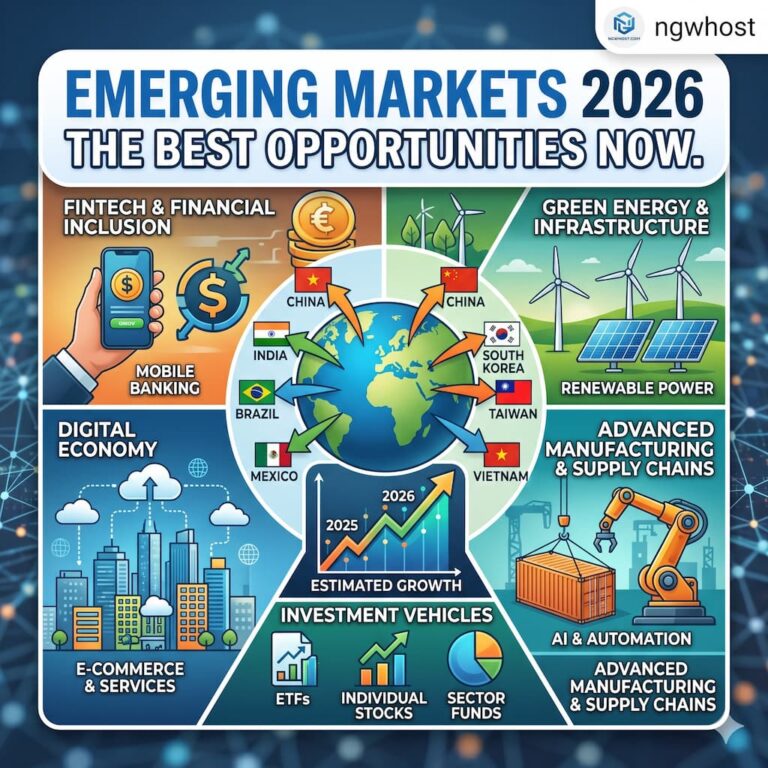

Emerging Markets 2026: Where to Find High Returns
The global investing paradigm has crossed a historic threshold. As we navigate through 2026, the traditional dominance of Developed Markets (DM) is facing structural headwinds. The story of the mid-2020s—characterized by high debt-to-GDP ratios in the West, sticky structural inflation, and a fragmented geopolitical map—has forced macro-allocators to look elsewhere for outsized alpha.
The clear winner of this transition is the Emerging Markets (EM) asset class. Following a stellar performance cycle where EM equities consistently outperformed developed markets, 2026 is solidifying into a multi-year bull run. Driven by an avalanche of AI infrastructure spending, decentralized fintech, supply-chain friend-shoring, and a structural weakness in the U.S. dollar, select emerging economies are flashing strong buy signals.
For the digital entrepreneurs, node operators, and tech-forward investors at ngwhost.com, understanding where and how capital is flowing into these high-growth regions is essential. This 1,500+ word comprehensive intelligence brief breaks down the top emerging market destinations, the high-return sectors driving their expansion, and the tactical framework required to safely maximize your yields this year.
1. The 2026 Macro Catalyst: Why EMs are Outperforming
To locate high returns in 2026, one must first realize that the modern Emerging Market is no longer just an exporter of raw commodities. The EM landscape has become heavily tech-centric, highly digitized, and fiscally disciplined.
                  ┌──────────────────────────────────────┐
                  │      2026 EM ALPHA CATALYSTS         │
                  └──────────────────┬───────────────────┘
                                     │
         ┌───────────────────────────┼───────────────────────────┐
         ▼                           ▼                           ▼
┌───────────────────┐       ┌───────────────────┐       ┌───────────────────┐
│  AI CAPEX BOOM    │       │ REGULATORY FLUIDITY│       │ DECENTRALIZED FIN │
│ Semiconductor &   │       │ Fiscal flexibility│       │ Stablecoin rails  │
│ Hardware Supply   │       │ & low debt-to-GDP │       │ B2B remittances   │
└───────────────────┘       └───────────────────┘       └───────────────────┘
The AI Hardware Supercycle
The defining macroeconomic event of 2026 is the staggering increase in global hyperscaler capital expenditure, which has surged past $650 billion. Because artificial intelligence demands massive compute power, specialized advanced processing nodes, and complex electronic supply chains, a vast percentage of this capital is landing directly in Asian and Latin American manufacturing hubs. EMs are providing the underlying computing bricks for the global AI revolution.
Lofty Earnings Growth Differentials
Corporate earnings growth tells a compelling story this year. In 2026, EM earnings are projected to expand by a massive 29%, more than double the consensus expectations for the United States (which sit at roughly 14%). Backed by rigorous corporate governance reforms and aggressive capital allocation strategies in countries like South Korea, India, and a recovering China, EM equities are trading at an attractive 45% discount to DM stocks relative to book value, offering an asymmetric margin of safety.
2. Top Jurisdictions for High Returns in 2026
The aggregate economic growth for EMs is hovering near a steady 4% year-on-year. However, beneath this stable headline lies significant regional divergence. True alpha in 2026 requires precise country picking.
A. India: The Unstoppable Infrastructure Engine
India continues its run as the fastest-growing major economy of the decade. The country has effectively decoupled from broader global slowdowns through structural domestic capitalization.
- The 2026 Play: Industrial manufacturing, advanced robotics, and banking. As institutional players like HDFC Bank expand their digital footprint, they are capturing the financial upside of a newly urbanized middle class.
- The AI Angle: India has transitioned from an outsourced IT service hub into a primary developer of Applied AI workflows, turning large language models into vertical enterprise applications for logistics and healthcare.
B. Taiwan & South Korea: The Hardware Monopolies
You cannot build the digital future without the hardware monopolies of East Asia.
- Taiwan (TSMC): Taiwan Semiconductor Manufacturing Company remains the single most critical chokepoint in the global economy, controlling nearly 90% of the world’s ultra-advanced computer chips. Despite lingering geopolitical cross-strait tensions, its unmatched technological lead in 2nm nodes makes it an irreplaceable high-return engine.
- South Korea (Memory Dominance): As high-bandwidth memory (HBM) becomes a scarce commodity required for AI processing units, South Korean giants are experiencing unprecedented margin expansion.
C. Brazil: The Clean Energy & Commodity Sovereign
In Latin America, Brazil has emerged as a beacon of macroeconomic stability. With public-debt ratios comfortably below developed market averages, its central bank has maintained fiscal flexibility that Western nations envy.
- The 2026 Play: Agribusiness tech, deep-water oil extraction, and green hydrogen infrastructure.
- Fintech Innovation: Brazil’s instant payment network, Pix, has evolved into a global blueprint for cashless utility. VCs are pouring capital into startups leveraging this network to build advanced credit, insurance, and B2B lending products.
D. Vietnam & Mexico: The Friend-Shoring Champions
As global fragmentation forces Western corporations to decouple their supply chains from traditional centers, Mexico and Vietnam have captured massive industrial windfalls.
- Mexico: Now the premier trading partner to the United States, its northern border regions are seeing real estate and industrial manufacturing booms fueled by multi-billion-dollar automotive and aerospace near-shoring projects.
- Vietnam: Acting as the primary alternative for electronics assembly, Vietnam’s advanced manufacturing sector is projected to expand by 25% by the end of 2026.
3. High-Performance Sectors Driving Returns
To find high returns, investors must align their capital with the specific secular trends dominating the EM landscape.
| Growth Sector | Primary EM Hubs | 2026 Target CAGR | Core Investment Theme |
| :--- | :--- | :--- | :--- |
| **Advanced Semiconductors** | Taiwan, South Korea | 22% - 25% | Hardware enabling the AI computing supercycle. |
| **Fintech & Stablecoin Rails** | Brazil, India, Nigeria | 18% | Financial inclusion, instant B2B cross-border settlement. |
| **Renewable Energy & Grids** | China, Brazil | 15% | Powering the massive energy demands of regional data centers. |
| **Advanced Manufacturing** | Vietnam, Mexico | 25% | Smart supply chains, automated logistics, near-shoring. |
| **Applied AI Applications** | India, China | 30% | Vertical AI software optimizing regional logistics and healthcare. |
1. Power Generation & Climate Tech
The massive AI buildout requires an equally massive energy buildout. EMs are leading the world in scaling renewable energy capacity to support localized data centers.
The Trend: Solar, wind, and next-generation energy storage systems (ESS) are seeing record capital allocations in China and Brazil. Corporate decarbonization mandates mean that factories and server farms are paying premium rates for verified green energy inputs, creating predictable, cash-flowing infrastructure yields for project developers.
2. Decentralized Finance (DeFi) & Cross-Border Rails
While Western regulators spend 2026 debating the definition of digital assets, emerging markets are using them out of sheer necessity. In regions experiencing currency volatility, Stablecoins (like USDC or regulated tokenized deposits) have become the preferred treasury asset for small-to-medium enterprises (SMEs). Startups building the payment gateways, B2B remittance rails, and digital banking applications that connect local fiat to digital dollars are experiencing exponential user acquisition metrics.
4. Tactical Framework: How to Allocate Capital Safely
Investing in emerging markets requires a sophisticated approach to risk management. High returns are invariably paired with unique structural risks.
Step 1: Use a “Core-and-Satellite” Allocation
- The Core (60%): Allocate the majority of your EM capital into broad, institutional-grade ETFs that track reformed indices. Look for funds with heavy allocations to India, South Korea, and Taiwan tech (e.g., the MSCI Emerging Markets Index, which has recently broken past its historical 2021 resistance levels).
- The Satellite (40%): Place high-conviction bets on specific, localized themes. This includes direct equities in near-shoring logistics firms in Mexico, or funding tokenized real-world assets (RWAs) backed by high-yield agricultural land in Brazil.
Step 2: Account for Currency Adjustments
A falling U.S. dollar is historically a massive tailwind for EMs, as it reduces the cost of servicing dollar-denominated sovereign debt and drives local currency appreciation. Ensure your portfolio includes exposure to Local Currency Bonds, which are currently yielding exceptional real returns due to the proactive, aggressive inflation-slashing rate policies implemented by EM central banks over the past two years.
Step 3: Verify Institutional Governance
Avoid companies that rely on state-directed subsidies without clear shareholder protection laws. In 2026, look for companies in South Korea and India that are actively undergoing Corporate Governance Enhancements—such as increasing dividend payouts, initiating share buybacks, and appointing independent board members.
5. Navigating the Risks of 2026
No EM guide would be complete without a realistic evaluation of potential pain points:
- Global Fragmentation and Tariffs: The ongoing economic competition between the U.S. and China means industrial policies can change overnight. A sudden tariff hike can disrupt a near-shoring corridor. Investors must focus on companies with diversified export structures that can easily pivot between Western and Eastern consumer bases.
- Energy and Supply Chain Bottlenecks: While advanced manufacturing is scaling fast, the underlying power grids in countries like Vietnam are occasionally pushed to their limits. Ensure your investments are anchored in companies that own or secure their own dedicated, renewable power grids.
- Systemic Shocks: A sudden energy price shock or a return of global headline inflation could compress margins across import-dependent EMs.
6. The Digital Synergy: The ngwhost.com Advantage
For the technology innovators reading this blog, the rise of Emerging Markets presents a dual opportunity. Not only are these regions incredible investment destinations, but they are also the fastest-growing consumer bases for digital services.
As millions of individuals in India, Latin America, and Southeast Asia enter the middle class, their demand for cloud hosting, e-commerce infrastructure, digital education, and localized applications is skyrocketing. By positioning your business or hosting services to serve these high-yield corridors, you create a natural hedge—earning operational revenue from the very same growth trends driving the global equity boom.
Read More⚡ Investing in Carbon Credits: A Guide for 2026
Conclusion: The Structural Rotation is Real
Emerging Markets in 2026 have transcended their old status as volatile, speculative plays. Supported by robust macroeconomic frameworks, low public-debt ratios relative to developed nations, and an irreplaceable positioning at the heart of the global AI and advanced manufacturing supply chains, they represent the premier frontier for capturing high investment returns.
The technical indicators are constructive, the earnings differentials are undeniable, and the valuation discount provides an institutional margin of safety. For the forward-looking allocator, the mandate for the remainder of 2026 is clear: Look beyond your local borders, understand the technological shifts shaping global alliances, and position your capital where the real growth is happening.