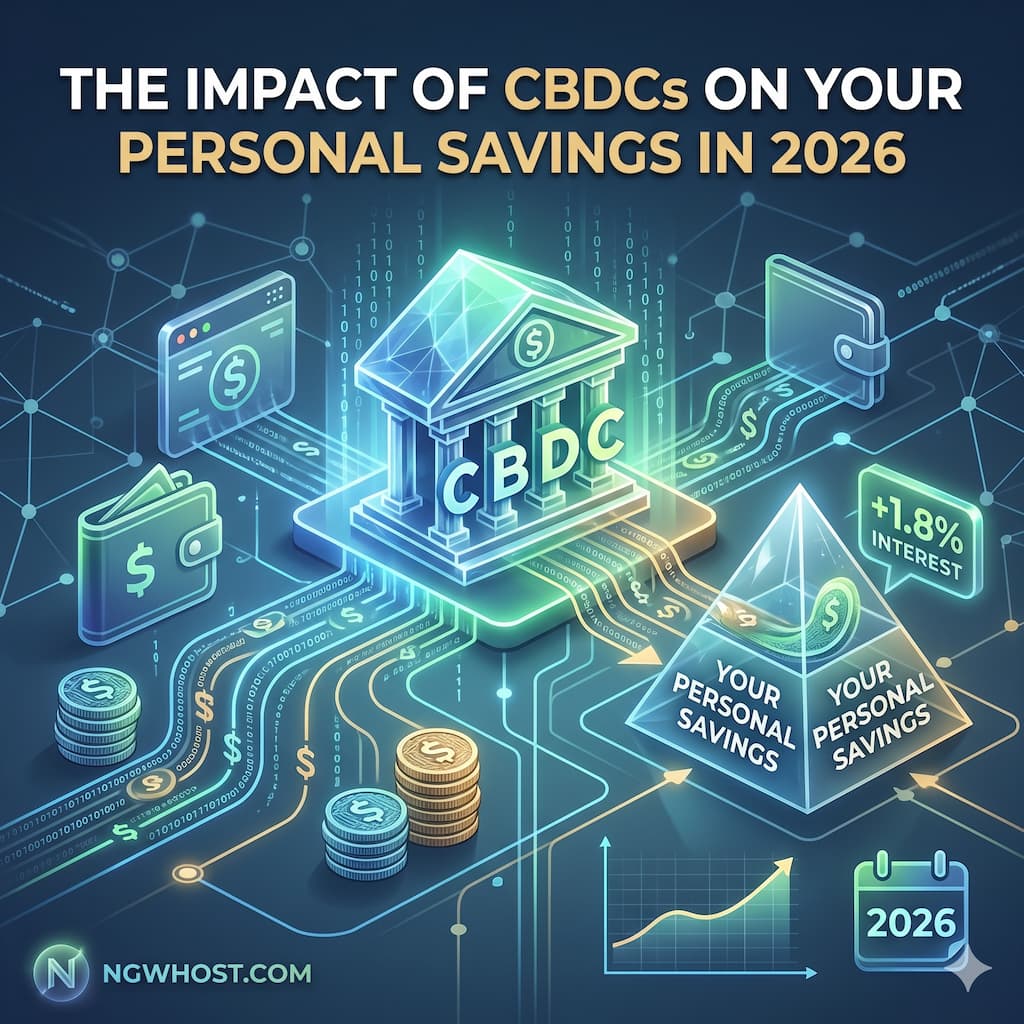
The Impact of CBDCs on Your Personal Savings in 2026
Welcome to 2026. If you reach into your pocket, you might find a stray coin or a crumpled bill, but for most of us, physical cash has become a nostalgic relic of the early 2020s. The financial world has moved under the hood, and the biggest driver of this shift isn’t Bitcoin or a new fintech app—it’s the Central Bank Digital Currency (CBDC).
Whether you call it the Digital Dollar, the Digital Euro, or—as we are seeing dominate the South American landscape—Drex, these government-backed digital tokens are fundamentally rewriting the rules of personal savings. For digital entrepreneurs, webmasters, and everyday savers, the “Impact of CBDCs” is no longer a whitepaper theory; it is a reality affecting your bank balance every single day.
In this deep dive, we’ll explore how CBDCs have changed the way we save, spend, and perceive the value of our labor in 2026.
1. What are CBDCs in 2026? (A Quick Refresher)
To understand the impact on your savings, we first need to define what we’re dealing with. A CBDC is essentially a digital version of a country’s fiat currency, issued and regulated by the central bank. Unlike Bitcoin, which is decentralized and volatile, a CBDC is centralized and stable. One Digital Dollar is always one Dollar.
By 2026, the technology has moved from pilot programs to full-scale integration. The standout feature of 2026’s financial landscape is Tokenization. We aren’t just moving “numbers” in an app; we are moving programmable tokens that can carry smart contracts, conditions, and automated rules.
2. The End of the Middleman: Direct Central Bank Access
The most immediate impact on your savings in 2026 is the changing role of commercial banks. Historically, you kept your savings in a private bank (like JP Morgan, HSBC, or Itaú). The bank used your money to issue loans and gave you a small slice of interest in return.
With CBDCs, the relationship has shifted.
- The Direct Ledger: In many jurisdictions, citizens now have the option to hold “Retail CBDC” accounts directly or indirectly tied to the Central Bank’s ledger. This makes your savings technically “risk-free” in terms of bank runs. A private bank can go bust; a Central Bank (theoretically) cannot.
- Disintermediation: Because you can hold money directly with the state, commercial banks have had to fight harder to keep your deposits. In 2026, this has led to a “savings war,” where traditional banks are forced to offer higher interest rates or specialized services (like advanced AI financial planning) just to stop you from moving your liquidity into a “pure” CBDC wallet.
3. The Double-Edged Sword of Programmable Money
This is where things get interesting—and a bit controversial. CBDCs are programmable. In 2026, the money in your digital wallet isn’t just a passive store of value; it can be instructed to behave in certain ways.
Negative Interest Rates & Stimulus
If the economy slows down, the Central Bank no longer has to wait for commercial banks to lower rates. They can apply a “holding fee” or a negative interest rate directly to your CBDC wallet. Imagine your savings account balance decreasing by 0.1% every month as a way to “encourage” you to spend and stimulate the economy.
Use-it-or-Lose-it Features
While not universally adopted, some 2026 pilots have experimented with “expiring money” for government stimulus. If the government sends you a rebate to help with rising energy costs, that specific token might have an expiration date of 90 days. This ensures the money is used for its intended purpose rather than being tucked away in a high-yield savings account.
4. Privacy: The Transparency Trade-off
For the privacy-conscious saver, 2026 is a challenging year. Every transaction made with a CBDC is recorded on a centralized ledger. While Central Banks claim this is essential to fight money laundering and tax evasion, it means the “anonymity” of physical cash is effectively dead.
- Financial Footprints: Your savings history is now a perfectly clear data set. For some, this is great—it makes getting a mortgage or a business loan almost instantaneous because your creditworthiness is baked into your ledger.
- The Oversight Risk: For others, the “Impact of CBDCs” represents an unprecedented level of government oversight. In 2026, the debate over “Financial Privacy Acts” is the top political issue globally. Can the government “freeze” your savings because of a political protest? Can they limit how much you spend on “unhealthy” items? The technical capability exists; only the law stands in the way.
5. CBDCs vs. Your Investment Portfolio
How should a savvy investor in 2026 balance their savings? The rise of CBDCs has shifted the “safe haven” status of various assets.
| Asset Class | Role in 2026 | Impact of CBDCs |
| CBDC (Savings) | Liquidity & Utility | Extremely high utility for daily payments; low growth potential. |
| Bitcoin/Crypto | Digital Gold | Has become the “anti-CBDC” hedge. Used by those seeking privacy and decentralization. |
| Tokenized Real Estate | Long-term Wealth | CBDCs (like Drex) have made it possible to buy 1% of an apartment via smart contracts. |
| Equities | Growth | Dividends are now paid out instantly and automatically via CBDC rails. |
In 2026, “saving” doesn’t just mean holding cash. It means holding a diversified basket of tokenized assets that interact with the CBDC rails.
6. The “Drex” Effect: A Success Story for E-commerce
Since ngwhost.com caters to digital entrepreneurs, we have to look at the business side. For online store owners, CBDCs have been a godsend for operational savings.
- Instant Settlement: No more waiting 2–3 days for a credit card processor to release your funds. In 2026, when a customer pays with a CBDC, the money is in your business savings account in seconds.
- Lower Fees: By cutting out the complex web of traditional payment processors, transaction fees have plummeted. This increases the “net savings” of every sale you make.
- Programmable Escrow: If you are running a service-based business, you can use CBDC smart contracts. The money is “saved” in an escrow token that only releases to your account once the digital product is delivered or the service is completed.
7. How to Prepare Your Personal Savings Strategy
If you’re looking at your bank account today and wondering how to navigate the rest of 2026, here is the roadmap:
- Maintain a “Hybrid” Wallet: Don’t put everything into the CBDC system. Keep a portion of your wealth in decentralized assets (Crypto) or physical assets (Gold/Real Estate) to ensure you have a “kill switch” if the centralized system experiences a glitch or overreach.
- Automate Your “Yield Farming”: In 2026, there are plenty of apps that automatically move your CBDC balance into short-term tokenized government bonds or “liquidity pools” the second your balance exceeds a certain threshold. Make your digital cash work for you every second.
- Stay Informed on “Programmability”: Read the terms of service of your digital wallet. Know if your money has “geofencing” (can only be spent in certain regions) or “category limits.”
- Embrace Tokenization: The real impact of CBDCs isn’t the currency itself; it’s the ability to buy fractions of other assets. Start looking into tokenized ETFs and real estate. Your “savings” should be a dynamic, tokenized ecosystem.
Read More⚡ Family Office vs. Private Banking: Which is for You?
Conclusion: The New Era of Financial Sovereignty
The impact of CBDCs on your personal savings in 2026 is best described as Efficient but Visible. We have gained immense speed, security, and lower costs. We have lost the shadows of the cash economy.
For the readers of ngwhost.com, the message is clear: the digital economy has finally matured. The wall between “the internet” and “money” has completely collapsed. Whether this leads to a golden age of financial inclusion or a dystopia of financial surveillance depends on the choices we make today regarding privacy laws and decentralized alternatives.
One thing is certain: your savings account is no longer a static number. It is a living, breathing, programmable piece of the global digital grid.
Summary Table: CBDC Pros and Cons for Savers (2026)
| The Good (Pros) | The Bad (Cons) |
| Zero Transaction Fees: No more middleman fees. | Loss of Privacy: Every cent is tracked on a ledger. |
| Instant Settlement: Money moves at the speed of light. | Programmability Risks: “Expiring” money or spending limits. |
| Risk-Free Storage: Direct access to Central Bank safety. | Centralized Control: Vulnerable to government “freezes.” |
| Smart Contracts: Automated savings and escrow. | Negative Rates: Easier for states to tax “hoarding.” |
Final Thought: In 2026, the best way to save is to stay educated. The digital landscape moves fast—ensure your hosting is reliable, your business is automated, and your financial assets are as decentralized as they are digital.