Robo-Advisors for HNWIs: 2026 Wealth Trends
The Programmable Evolution of Wealth Preservation
For the better part of the last decade, the term “robo-advisor” was intrinsically linked to retail investing. The narrative was simple: an algorithm takes a brief questionnaire about your risk tolerance, deposits your monthly contributions into a generic portfolio of six to eight low-cost Exchange Traded Funds (ETFs), and automatically rebalances it every quarter. It was an elegant solution for the mass market, democratizing access to basic portfolio theory. However, for High-Net-Worth Individuals (HNWIs)—those managing portfolios in excess of $5 million, $10 million, or $50 million—these retail-grade algorithms were fundamentally inadequate.
Retail robo-advisors treat capital as a monolith. But at the HNWI tier, wealth is highly fragmented, fiercely complex, and encumbered by aggressive tax liabilities, illiquid alternative investments, generational trust structures, and cross-border compliance mandates.
As we navigate 2026, the technology underlying automated wealth management has undergone a profound architectural shift. We have moved from simple rules-based rebalancing scripts to highly sophisticated, computationally intensive artificial intelligence engines. For the digital operators, infrastructure architects, and successful tech entrepreneurs forming the core community of ngwhost.com, wealth management is no longer viewed as a financial service; it is viewed as a software engineering challenge.
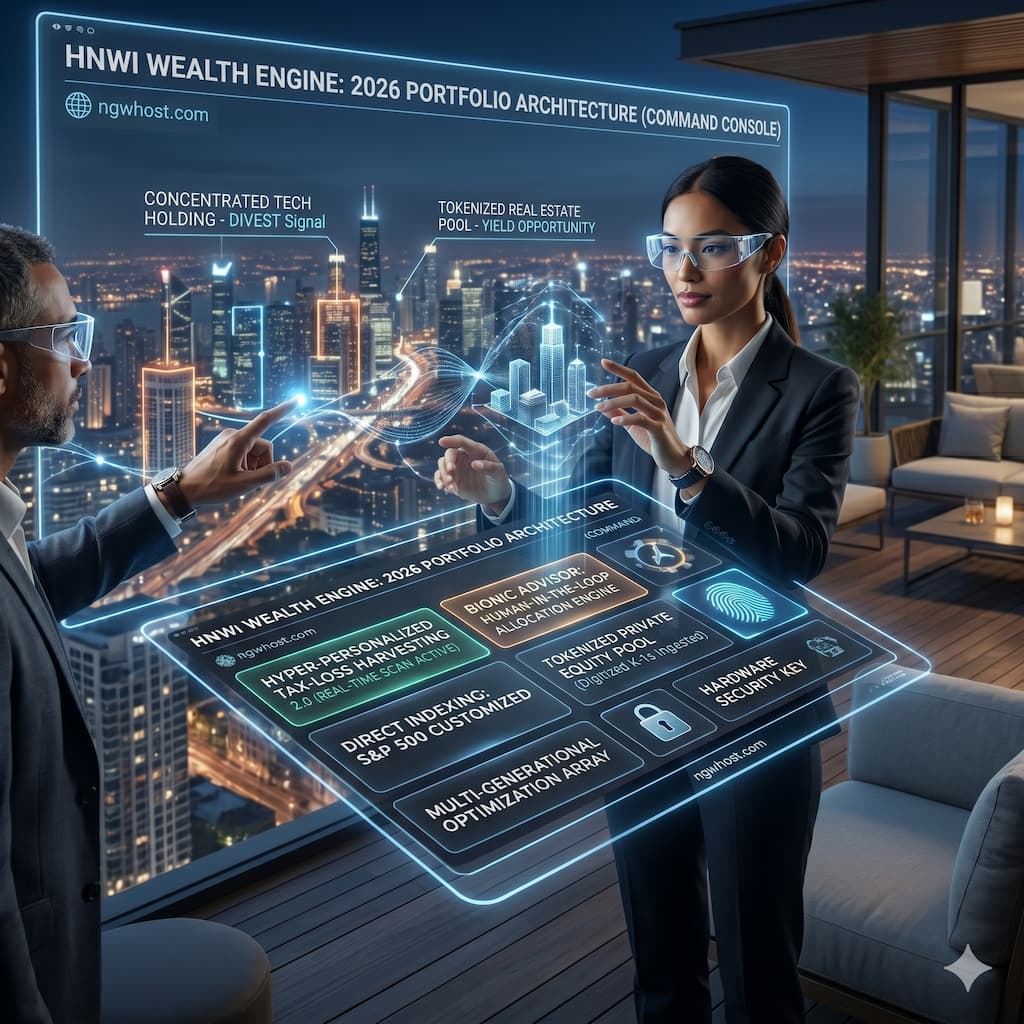
The next generation of robo-advisors—often referred to as Algorithmic Wealth Engines or “Bionic” Advisors—is merging Wall Street financial theory with Silicon Valley server infrastructure. This comprehensive analysis explores the specific technological trends and infrastructural breakthroughs driving the adoption of algorithmic wealth management among High-Net-Worth Individuals in 2026.
1. The Architectural Shift: From Generic ETFs to Direct Indexing at Scale
The most significant technological leap in HNWI wealth tech is the death of the standard ETF wrapper in favor of Algorithmic Direct Indexing.
When you purchase an S&P 500 ETF, you own a single derivative asset that represents 500 companies. You cannot exclude specific companies, nor can you harvest tax losses from the individual losers within that index if the overall ETF is up. For a retail investor, this is fine. For a HNWI, it is a massive missed opportunity for optimization.
The Computational Power of Direct Indexing
Direct Indexing requires the robo-advisor to bypass the ETF entirely. Instead of buying one ticker, the algorithm uses high-frequency API connections to institutional brokerages to directly purchase fractional shares of all 500 underlying companies in their exact index weightings.
From an infrastructural standpoint, managing a Direct Indexing portfolio for thousands of HNWI clients requires immense database throughput and low-latency execution. The algorithm must track hundreds of thousands of individual tax lots in real-time.
ESG and Concentrated Position Customization
Why does this matter for the HNWI? Programmability. If an entrepreneur recently sold a massive SaaS company and was compensated heavily in Microsoft stock, their portfolio is dangerously concentrated in tech. A 2026 robo-advisor uses Direct Indexing to build a customized index that algorithmically strips out all competing tech stocks to hedge the client’s risk, automatically recalculating the weights of the remaining 490 companies to maintain the desired tracking error.
Furthermore, the HNWI can input specific ethical parameters. Through advanced Natural Language Processing (NLP) and data scraping, the algorithm can actively monitor the global news cycle and instantly divest from individual companies whose supply chains violate the client’s specific ESG (Environmental, Social, and Governance) parameters, dynamically replacing them with statistically correlated alternatives to maintain portfolio performance.
2. Hyper-Personalized, High-Frequency Tax-Loss Harvesting (TLH 2.0)
Taxes are the single largest drag on compounded wealth. At the highest marginal tax brackets, saving capital from the IRS is mathematically identical to generating alpha in the market. The retail versions of Tax-Loss Harvesting (TLH) typically scan a portfolio once a month or at year-end to sell losing positions, realize a loss to offset gains, and buy a proxy asset to stay invested.
For the 2026 HNWI, this batch-processing approach is obsolete. Modern algorithmic wealth engines utilize Continuous, High-Frequency Tax-Loss Harvesting.
Intraday Algorithmic Scanning
Markets are volatile. A stock might drop 5% on a Tuesday morning and recover by Tuesday afternoon. A legacy wealth manager or a retail robo-advisor will miss this opportunity entirely. Modern HNWI algorithms run continuous, intraday scans across tens of thousands of individual stock lots within the Direct Indexing framework.
When the algorithm detects an intraday dip that crosses a predefined mathematical threshold, it instantly executes an API call to sell the specific lot, banks the capital loss to offset the client’s future capital gains, and simultaneously buys a highly correlated proxy stock to maintain the portfolio’s market exposure without violating the “Wash Sale” rule.
Multi-Account, Multi-Generational Optimization
The computational complexity scales exponentially when dealing with HNWI structures. An algorithmic advisor in 2026 doesn’t just look at a single brokerage account; it connects via secure APIs (such as Plaid’s enterprise tier) to the client’s entire financial ecosystem: revocable trusts, Corporate Treasury accounts, self-directed IRAs, and offshore holding companies.
The AI calculates the optimal “Asset Location.” It algorithmically determines that high-yield, tax-inefficient corporate bonds should be physically housed in the tax-advantaged IRA, while highly aggressive, volatile growth equities are housed in the taxable account to maximize the tax-loss harvesting potential. This requires the backend server architecture to run millions of Monte Carlo simulations daily, calculating the probabilistic tax liabilities of cross-account movements before executing a single trade.
3. The Integration of Illiquid Alternatives and Tokenized Private Equity
The traditional 60/40 portfolio (60% equities, 40% bonds) is dead at the institutional level. The Yale Endowment Model proved that outsized returns are generated in private, illiquid markets: Venture Capital, Private Equity, Private Credit, and Commercial Real Estate.
Historically, robo-advisors completely ignored these assets because they are notoriously difficult to price, lack daily liquidity, and exist as PDFs and K-1 tax forms rather than clean data streams.
AI-Driven Unstructured Data Ingestion
In 2026, the technological bottleneck has been broken. HNWI robo-advisors are deploying advanced Large Language Models (LLMs) and optical character recognition (OCR) systems to ingest unstructured data from private equity portals. When a private equity fund issues a quarterly report or a capital call, the AI instantly reads the document, extracts the updated valuation metrics, and pushes that data into the client’s master database.
Holistic Algorithmic Rebalancing
Once the illiquid assets are digitized into the system, the true power of the algorithm is unlocked. If a HNWI holds 25% of their wealth in a highly illiquid real estate syndicate, the robo-advisor dynamically adjusts the public, liquid side of the portfolio to compensate.
If the real estate market drops (detected via macroeconomic API feeds), the algorithm might automatically increase the risk profile of the public equity allocation to maintain the target return rate, or shift capital into liquid Treasuries to ensure the client has enough cash on hand to meet upcoming private equity capital calls. The entire net worth is treated as a single, breathing, mathematically connected organism.
Furthermore, with the rise of asset tokenization on secure institutional blockchains, we are seeing the first wave of algorithms that can actually trade fractionalized private equity shares on secondary digital markets, finally bringing a layer of programmatic liquidity to traditionally frozen assets.
4. Institutional-Grade Security, Self-Custody, and The Sovereign Infrastructure
For the readers of ngwhost.com—professionals who understand server vulnerabilities, DDoS attacks, and the absolute necessity of zero-trust environments—the idea of handing over API keys and complete control of a $20 million portfolio to a cloud-based algorithm is inherently terrifying.
As wealth tech evolves, the security architecture has had to mature from standard web app security to military-grade cryptographic infrastructure.
The Rise of API-Driven Self-Custody
In previous iterations of wealth management, you had to surrender custody of your assets to the advisory firm. Today, tech-savvy HNWIs are demanding a disaggregated model. They hold their assets in secure, highly regulated custodians (or, for digital assets, in institutional cold storage and multi-signature hardware wallets).
The robo-advisor is granted execution-only API access. The algorithm can rebalance the portfolio, execute tax-loss harvesting trades, and adjust weightings, but it physically cannot initiate a withdrawal or transfer funds out of the custodian. If the robo-advisor’s servers are compromised, the hacker might scramble the portfolio allocation, but they cannot steal the underlying capital.
Zero-Trust and Biometric Authentication Overlays
Because these platforms handle sensitive financial data and integrate with global tax reporting systems, their backend infrastructures are built on Zero-Trust architectures. This means continuous authorization is required for every internal microservice.
For the client, interacting with the algorithmic engine requires sophisticated multi-factor authentication (MFA) that goes far beyond SMS codes. High-tier platforms in 2026 require hardware security keys (like YubiKeys) and cryptographic biometric sign-ins to alter fundamental algorithm parameters—such as changing risk tolerance or altering ESG exclusion lists. The platform is not just a financial tool; it is a digital fortress.
5. The “Bionic” Model: Human-in-the-Loop (HITL) Wealth Architecture
Despite the staggering computational power of modern algorithmic engines, the most successful trend in 2026 is not the total elimination of the human financial advisor. Instead, it is the rise of the “Bionic” Advisor or the Human-in-the-Loop (HITL) model.
When dealing with a $30 million estate, the challenges are rarely just mathematical; they are deeply emotional, legal, and psychological. An algorithm can perfectly execute a tax-loss harvesting strategy during a 30% market crash, but an algorithm cannot look a panicked entrepreneur in the eye and prevent them from manually overriding the system and liquidating their assets out of fear.
Furthermore, algorithms cannot currently draft complex legal trust documents, mediate inheritance disputes between siblings, or creatively structure a philanthropic foundation.
The Advisor as a Systems Architect
In the 2026 landscape, the human wealth manager has transitioned from being a stock-picker to being a systems architect. They no longer spend their days building Excel spreadsheets or executing trades. The machine does the heavy lifting of portfolio theory, rebalancing, and tax optimization flawlessly and instantly.
The human advisor acts as the “prompt engineer” for the client’s financial life. They interpret the client’s complex, abstract life goals—like funding a grandchild’s education while shielding assets from corporate liability—and translate those goals into the precise mathematical parameters, risk constraints, and API inputs required to feed the algorithmic engine.
By automating the quantitative workflows, the human advisor is freed to focus entirely on qualitative value: behavioral coaching, deep estate planning, and bespoke financial structuring.
Read More⚡ Top 5 Global Tech Stocks to Hold for the Next Decade
Conclusion: The Era of Programmable Capital
The financial services industry is experiencing the exact same digital disruption that transformed media, retail, and server infrastructure. The bespoke, white-glove wealth management services that were once housed in mahogany boardrooms on Wall Street have been digitized, optimized, and deployed to the cloud.
For the modern High-Net-Worth Individual, settling for generic, static portfolio management is an active acceptance of inefficiency. The wealth trends of 2026 dictate that capital must be treated as programmable data.
By leveraging algorithmic Direct Indexing, utilizing APIs to achieve intraday tax optimization, seamlessly integrating illiquid private equity through AI data ingestion, and securing the entire perimeter with zero-trust architectural frameworks, modern wealth tech is fundamentally altering the trajectory of compounded growth.
You spent your career engineering highly optimized, scalable digital businesses and robust server environments. In 2026, there is absolutely no reason your wealth preservation strategy shouldn’t be built on the exact same high-performance principles.
To stay ahead of the curve on digital infrastructure, algorithmic systems, and the technologies powering the modern web and global finance, continue exploring the deep-dive technical resources available right here at ngwhost.com.