Best Real Estate Investment Trusts (REITs) to Watch in 2026
The Physical Backbone of the Digital Economy
When we discuss the future of the digital economy, the conversation naturally gravitates toward artificial intelligence, cloud architecture, high-frequency trading algorithms, and omnichannel e-commerce. However, the internet is not a formless entity floating in the ether. It is a massive, physical machine. Every line of code, every database query, and every online transaction is processed by silicon chips housed in highly secured facilities, transmitted through thousands of miles of subterranean fiber-optic cables, and ultimately delivered via physical logistics networks.
For digital entrepreneurs, systems administrators, and technology investors managing platforms like ngwhost.com, understanding the physical layer of the web is paramount. This intersection of technology and physical property is where Real Estate Investment Trusts (REITs) come into play.
In 2026, the real estate market has fully transitioned from the interest rate volatility of the early 2020s into a period of stabilized, tech-driven growth. REITs—companies that own, operate, or finance income-producing real estate—offer a unique vehicle for investors to gain exposure to the massive infrastructure demands of the modern world while generating consistent, high-yield dividend income. By law, REITs must distribute at least 90% of their taxable income to shareholders, making them exceptional tools for compounding wealth.
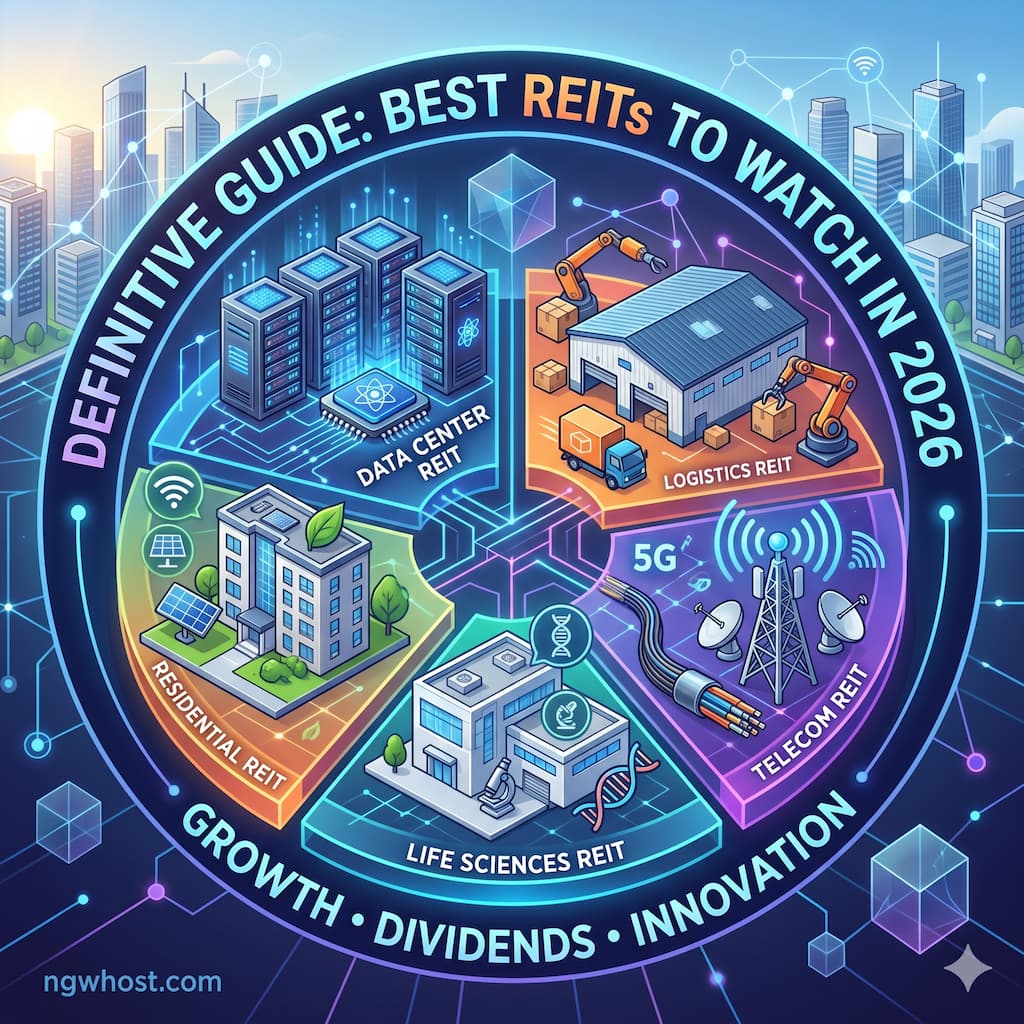
This comprehensive guide breaks down the most critical REIT sectors for 2026, analyzing the specific assets and market dynamics that are powering the next generation of digital and physical commerce.
1. Data Center REITs: The Landlords of the Cloud
There is no sector more critical to the global economy in 2026 than data centers. The exponential growth of Generative AI, machine learning training models, and autonomous systems has created an insatiable demand for computational power. This demand has fundamentally altered the architecture of data centers, shifting the focus from simple storage space to extreme power density and advanced cooling capabilities.
The Power and Cooling Paradigm
Modern server racks, particularly those housing advanced GPUs used for AI, generate immense heat. Older data centers relying on traditional HVAC air cooling are becoming obsolete. The premier Data Center REITs in 2026 are those that have successfully retrofitted their facilities or built new campuses equipped with direct-to-chip liquid cooling and immersion cooling technologies. Furthermore, with global power grids under severe strain, data centers that have secured long-term, low-cost renewable energy contracts possess a massive competitive moat.
Key Players to Watch
- Equinix, Inc. (EQIX): Equinix remains the undisputed global leader in digital infrastructure and colocation. Their business model thrives on the “network effect.” Because major telecom providers, cloud giants (AWS, Google Cloud, Azure), and financial institutions all house their core routing equipment in Equinix facilities, new companies are virtually forced to lease space there to achieve ultra-low latency interconnections. In 2026, Equinix’s expansion into quantum-safe networking hubs makes it a foundational asset for the future of enterprise IT.
- Digital Realty Trust (DLR): While Equinix focuses heavily on retail colocation and interconnection, Digital Realty dominates the wholesale and hyperscale market. When a major tech conglomerate needs a dedicated, 50-megawatt facility to train a new massive language model, they lease it from Digital Realty. Their global footprint and aggressive investments in sustainable, low-PUE (Power Usage Effectiveness) architecture make them highly attractive to institutional investors operating under strict ESG mandates.
2. Industrial and Logistics REITs: The Engine of Modern Commerce
The e-commerce landscape has evolved dramatically. The rise of social commerce, dynamic video-based shopping platforms, and immediate consumer gratification has made the physical supply chain the ultimate differentiator between retail success and failure. For brands executing high-volume sales through integrated platforms like TikTok Shop or direct-to-consumer funnels, the speed of fulfillment is non-negotiable.
The Automation Revolution in Warehousing
Industrial REITs do not simply own empty tin sheds. The most valuable assets in 2026 are highly specialized logistics hubs located immediately adjacent to major metropolitan centers—often referred to as “last-mile” facilities. These warehouses feature reinforced concrete floors capable of supporting heavy robotic systems, elevated ceilings for Automated Storage and Retrieval Systems (AS/RS), and massive electrical capacities to charge fleets of electric delivery vehicles overnight.
Key Players to Watch
- Prologis, Inc. (PLD): Prologis is the largest industrial real estate company in the world, and its sheer scale provides an unmatched advantage. They control the most strategic logistics corridors globally. In 2026, Prologis has expanded its revenue streams beyond simply collecting rent. Through their Prologis Essentials program, they are effectively operating as a utility and service provider, selling solar energy generated from their massive warehouse rooftops directly to their tenants, and providing turnkey robotic automation solutions.
- Rexford Industrial Realty (REXR): Rexford operates with a hyper-focused strategy: they exclusively own industrial properties in Southern California. This region is the gateway for Asian imports into the United States and is characterized by a massive population base combined with virtually zero available land for new warehouse construction. This extreme supply-demand imbalance allows Rexford to continuously drive up rental rates, generating exceptional returns for shareholders.
3. Telecommunications and Infrastructure REITs: The Edge Computing Frontier
If data centers are the brain of the internet and logistics centers are the muscles, telecommunications infrastructure is the nervous system. The continued rollout of ultra-wideband 5G, alongside the preparatory infrastructure for 6G networks, requires a massive densification of cellular transmission points.
The Shift to the Edge
In 2026, the concept of “Edge Computing” is fully operationalized. Cell towers are no longer just passive steel structures holding radio antennas. The base of these towers is increasingly being transformed into micro-data centers. By processing data at the extreme edge of the network—physically closer to the user’s smartphone, autonomous vehicle, or IoT sensor—latency is reduced to single-digit milliseconds. This infrastructure is the prerequisite for the next wave of augmented reality and autonomous logistics.
Key Players to Watch
- American Tower Corporation (AMT): Operating over 220,000 communications sites globally, American Tower offers incredible revenue visibility. Their leases with major telecom carriers typically span 5 to 10 years and include built-in annual rent escalators. Furthermore, a single tower can accommodate multiple tenants (e.g., Verizon, AT&T, and T-Mobile can all lease space on the same structure), meaning the marginal cost of adding a new customer is close to zero, resulting in massive profit margins.
- Crown Castle Inc. (CCI): Unlike American Tower, which has a vast international presence, Crown Castle is heavily focused on the U.S. domestic market. They are the premier operators of “small cell” nodes and fiber-optic networks. Small cells are critical for urban 5G coverage, where high-frequency signals cannot penetrate buildings easily. Crown Castle’s extensive fiber network perfectly positions them to serve as the critical backhaul providers for the edge computing revolution.
4. Specialized Real Estate: Life Sciences and Technological Hubs
While the traditional commercial office sector (specifically Class B and Class C buildings in downtown business districts) continues to struggle with the permanent shift toward hybrid and remote work, highly specialized office spaces are thriving. The demand for physical spaces that cannot be replicated in a home office environment remains robust.
The Biotech and R&D Boom
Life sciences real estate requires highly specialized infrastructure. These buildings must have heavy-duty HVAC systems capable of massive air cycling, reinforced flooring for heavy laboratory equipment, specialized chemical disposal systems, and redundant backup power to prevent the loss of years of delicate biological research.
Key Players to Watch
- Alexandria Real Estate Equities (ARE): Alexandria pioneered the life science real estate niche. They focus entirely on developing collaborative, high-tech campus environments in the nation’s top innovation clusters—such as Boston/Cambridge, the San Francisco Bay Area, and San Diego. Their tenants are the most well-funded pharmaceutical companies, cutting-edge biotech startups, and government research institutions. Because the cost of relocating a complex laboratory is astronomically high, Alexandria enjoys incredibly high tenant retention rates and stable cash flows.
5. Residential REITs: The High-Tech Housing Paradigm
Despite the focus on commercial and industrial infrastructure, housing remains a fundamental human necessity. The global structural deficit in housing supply continues to support the valuation of Residential REITs in 2026. However, the expectations of the modern renter have evolved.
The Digital Nomad and the Smart Building
Today’s premium renters—often tech workers, developers, and digital entrepreneurs—demand more than just square footage. They expect gigabit fiber-optic internet wired directly into the unit, smart home automation (climate control, keyless entry, advanced security), and integrated co-working spaces within the building to support their remote work lifestyles.
Key Players to Watch
- AvalonBay Communities (AVB): AvalonBay is a premier developer and operator of high-end apartment communities in high barrier-to-entry coastal markets. They have aggressively integrated property technology (PropTech) into their operations. From automated self-guided tours using smart locks to AI-driven dynamic pricing algorithms for rent optimization, AVB utilizes technology to drive down operating expenses and maximize Net Operating Income (NOI).
- Mid-America Apartment Communities (MAA): For investors looking to capitalize on demographic shifts, MAA is heavily concentrated in the Sunbelt region of the United States. This area continues to see massive inbound migration due to lower taxes, pro-business environments, and the relocation of major technology manufacturing hubs. MAA provides high-quality workforce housing that captures the economic growth of these rapidly expanding tech corridors.
6. How to Evaluate REITs in 2026: The Financial Metrics
For those accustomed to analyzing tech stocks using Price-to-Earnings (P/E) ratios or SaaS multiples, evaluating a REIT requires a different financial vocabulary. Because real estate involves heavy depreciation (which is an accounting deduction but not an actual cash expense), traditional net income metrics can be highly misleading.
When analyzing the REITs mentioned above, investors should focus on the following critical metrics:
- Funds From Operations (FFO): This is the gold standard metric for REITs. FFO takes the standard net income, adds back the depreciation and amortization of real estate assets, and subtracts any gains on the sale of properties. It provides a highly accurate picture of the actual cash generated by the core operations of the real estate portfolio.
- Adjusted Funds From Operations (AFFO): Taking analysis a step further, AFFO subtracts the recurring capital expenditures required to maintain the properties (e.g., replacing the roof on an industrial warehouse or upgrading the HVAC in a data center). AFFO represents the true cash available to pay out dividends to shareholders.
- Capitalization Rate (Cap Rate): The cap rate is the net operating income of a property divided by its current market value. In 2026, understanding cap rates is crucial for assessing whether a REIT is buying properties at a fair price relative to the prevailing risk-free interest rates.
- Debt Maturation Schedule: Real estate is a highly leveraged business. In a stabilized, but historically normalized interest rate environment, a REIT with a massive amount of debt maturing in the next 12 months will be forced to refinance at current market rates, potentially crushing their profit margins. The best REITs in 2026 have staggered debt maturities and rely heavily on fixed-rate, long-term financing.
Read More⚡ Sustainable Investing: Green Bonds and Funds to Watch in 2026
Conclusion: Building a Resilient Digital Portfolio
As the lines between the physical and digital worlds continue to blur, the strategy for long-term wealth generation must adapt. While building digital assets, optimizing server architecture, and scaling online brands are fantastic engines for active income and aggressive growth, integrating real estate into your financial strategy provides an essential layer of defensive stability.
In 2026, investing in Real Estate Investment Trusts is not a departure from the technology sector; it is a doubling down on its foundation. By allocating capital toward Data Center REITs, you are effectively buying the concrete and cooling systems that allow the cloud to exist. By investing in Industrial REITs, you are claiming a stake in the robotic supply chains that make instant e-commerce fulfillment possible.
For the modern digital professional, a well-structured portfolio of high-quality, tech-adjacent REITs offers the ultimate financial synergy: leveraging the high-margin, scalable profits of the digital world to purchase the finite, cash-flowing physical assets that sustain it.