Sustainable Investing: Green Bonds and Funds to Watch in 2026
The Financial and Technological Imperative of a Green Web
The intersection between high-performance digital technology and global finance has never been more critical than it is in 2026. For years, “sustainable investing” or ESG (Environmental, Social, and Governance) strategies were viewed by many corporate executives as a public relations exercise or a secondary metric relegated to the end of annual reports. Today, that reality has undergone a fundamental transformation. Sustainability has evolved into the primary engine of institutional capital allocation and an absolute operational necessity for tech-intensive enterprises.
For digital infrastructure platforms, cloud providers, and web hosting enterprises like ngwhost.com, energy consumption is arguably the most significant logistical and financial challenge of the decade. With the explosive growth of artificial intelligence processing, large language models, and the massive global expansion of hyperscale data centers, the demand for electricity has reached unprecedented levels. The financial markets have responded to this demand by channeling trillions of dollars into the energy transition through specialized investment vehicles, most notably Green Bonds and ESG Funds.
The internet is not a cloud of immaterial data; it is a massive, physical machine consisting of servers, cooling towers, and fiber optic cables. Every HTTP request, every database query, and every SSL handshake consumes power. This comprehensive guide explores the landscape of sustainable investments in 2026, detailing how Green Bonds actually function, which funds are leading the clean energy revolution, and why digital entrepreneurs, systems administrators, and IT infrastructure managers must integrate these assets into both their corporate treasuries and personal portfolios.
1. Demystifying Green Bonds: The Engine of the Energy Transition
Before analyzing the specific assets poised for growth in 2026, it is crucial to understand the fundamental mechanics behind sustainable debt. Green Bonds are traditional fixed-income instruments with one vital distinction: the capital raised through the issuance of the bond is strictly “ring-fenced” and allocated exclusively to finance projects that generate a quantifiable, positive environmental impact.
How Do Green Bonds Work in Practice?
When a corporation—such as a multinational technology conglomerate building a new server farm—or a sovereign government needs to raise capital for a renewable energy initiative, they issue a Green Bond. Investors purchase these bonds, effectively lending money to the issuer in exchange for regular interest payments (known as coupons) and the return of the principal amount upon the bond’s maturity.
The projects financed by these instruments typically fall into several core categories:
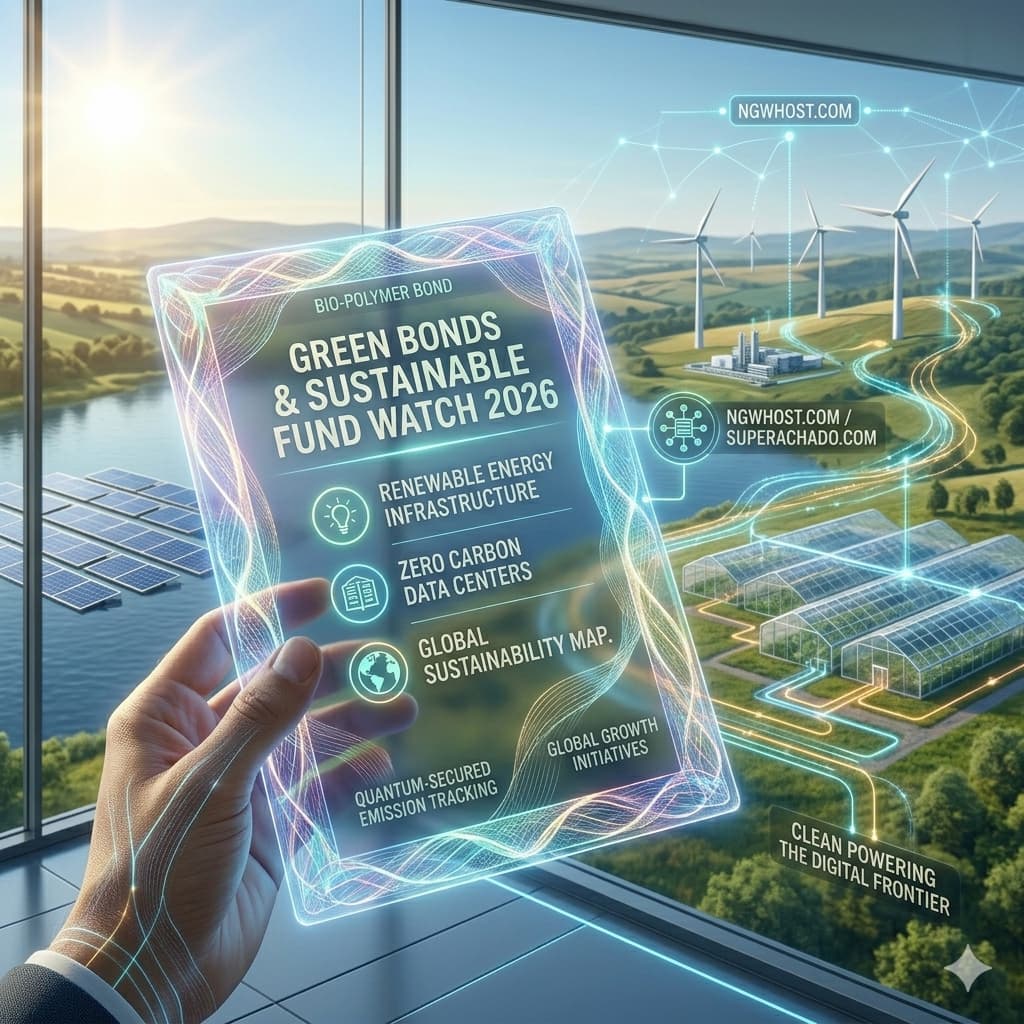
- Renewable Energy Infrastructure: The construction of offshore wind farms, industrial-scale solar arrays, and low-impact hydroelectric facilities.
- Energy Efficiency Upgrades: The modernization of smart electrical grids and the implementation of advanced cooling infrastructures for data centers. This directly targets the reduction of PUE (Power Usage Effectiveness), a critical metric for hosting providers.
- Clean Transportation: Financing the infrastructure for electric vehicle (EV) charging networks and low-carbon logistics supply chains.
- Sustainable Water Management: Advanced water purification, desalination, and closed-loop reuse technologies, which are increasingly vital for the liquid cooling systems required by modern, high-density server racks.
The Evolution of the “Green Standard” in 2026
In 2026, the Green Bond market has reached a state of profound maturity. In the early 2020s, “greenwashing”—the practice of issuing bonds under the guise of sustainability to fund operations that were not genuinely clean—was a persistent systemic issue. Today, global regulatory bodies (such as the refined EU Taxonomy and strict SEC guidelines in the US) have established draconian rules for issuance. Furthermore, AI-driven auditing and real-time IoT data monitoring now ensure that the capital invested in a Green Bond is traceable down to the specific megawatt-hour of clean energy generated.
2. The Crucial Intersection of Web Hosting and Green Finance
Why should a platform focused on web infrastructure and hosting technology, such as ngwhost.com, concern itself with the intricacies of sustainable finance? The answer lies in the fundamental supply chain of the digital economy.
The Carbon Footprint of the Global Internet
As previously noted, the digital economy relies on physical infrastructure that operates 24 hours a day, 7 days a week. It is estimated that in 2026, global IT infrastructure—encompassing data centers, transmission networks, and connected devices—accounts for a substantial and rapidly growing percentage of global greenhouse gas emissions. The energy required to cool a single rack of AI-optimized servers can easily surpass the energy required to power a small residential neighborhood.
The Strategic Hedge for Tech Companies
For digital entrepreneurs and infrastructure owners, investing in Green Bonds is not merely an ethical consideration; it is a highly strategic financial hedge.
- Financial Returns on Carbon Offsetting: Instead of simply purchasing carbon credits, which represent a sunk operational cost, technology companies are increasingly purchasing Green Bonds. This strategy allows them to directly finance the exact renewable energy infrastructure that will eventually power their own servers, all while earning a predictable financial yield on the invested capital.
- B2B and Consumer Demand: Corporate clients today mandate that their hosting providers possess verifiable “Green Hosting” certifications, proving that their operations are powered by 100% renewable energy. By allocating corporate treasury funds into sustainable investments that build clean energy matrices, platforms secure their supply chain while projecting authority and a genuine commitment to the sustainable future of the web.
3. Corporate and Sovereign Green Bonds to Watch in 2026
This year, both the secondary market and new issuances offer robust opportunities for investors seeking the relative safety of fixed-income assets combined with alignment to sustainable technological growth.
Tech Corporate Bonds (The Hyperscalers)
The world’s largest technology companies are currently the largest corporate buyers of renewable energy globally. To finance their aggressive transitions to “Net Zero” emissions, they are issuing highly sought-after green debt.
- Apple and Alphabet Green Bonds: Possessing balance sheets stronger than many sovereign nations, these tech giants continue to issue bonds to finance low-carbon chip manufacturing processes, massive solar-powered data centers, and grid-level battery storage projects. These bonds offer competitive yields with virtually zero default risk, making them an excellent conservative anchor for any corporate or personal portfolio.
- Data Center REIT Infrastructure Bonds: Real Estate Investment Trusts (REITs) that specialize in data centers—such as Equinix or Digital Realty—are critical entities to watch. They are issuing green bonds specifically to finance the architectural overhaul of their facilities. These funds are used to retrofit older data centers with advanced liquid cooling technologies and AI-driven HVAC systems, which can reduce energy consumption by up to 40%. Investing in these bonds is a direct bet on the sustainable future of web hosting.
Sovereign and Municipal Green Bonds
Governments worldwide are financing national energy transitions through the issuance of public debt.
- The European Union (NextGenerationEU): Europe remains the undisputed leader in the sovereign green bond market. The bonds issued under the EU’s expansive climate programs offer massive liquidity and are considered among the safest assets in the world in 2026. They are actively financing the continent’s accelerated transition away from fossil fuel dependency.
- Emerging Market Green Bonds: Countries in Latin America and Asia are issuing sovereign green bonds with significantly higher yields. Brazil, for instance, has made substantial strides in issuing bonds tied to sustainable agriculture, reforestation, and the development of green hydrogen infrastructure. These offer highly attractive returns for investors willing to absorb emerging market risk profiles.
4. ESG and Clean Energy ETFs: Diversification for Digital Investors
For the digital investor who prefers not to analyze and purchase individual bonds, Exchange Traded Funds (ETFs) offer instant, liquid diversification across entire sectors of the green economy. By 2026, the ETF landscape has undergone rigorous filtering, eliminating funds that merely utilized the “ESG” label as a marketing gimmick.
Here are the critical ETF categories and specific funds to monitor closely:
Clean Energy and Infrastructure ETFs
These funds invest in a diversified basket of global corporations focused on solar, wind, battery technology, and smart grid infrastructure.
- iShares Global Clean Energy ETF (ICLN): This remains one of the most established and liquid funds in the sector. It focuses on companies that produce energy from renewable sources or manufacture the necessary equipment (like wind turbines and solar inverters). With the relentless demand for clean energy required to power global web infrastructure, the companies held within ICLN possess a guaranteed demand pipeline for decades to come.
- Invesco Solar ETF (TAN): Focused purely on the solar energy sector, this ETF reflects the accelerated adoption of photovoltaic technology at both the utility and residential levels. Breakthroughs in solar cell efficiency and manufacturing in 2026 have positioned this fund as an aggressive growth vector.
Water Innovation and Scarcity ETFs
Water is arguably the most critical resource of the 21st century. For the technology and hosting industry, water is absolutely essential for the cooling of high-density servers. Regional water scarcity directly threatens the operational viability of data centers.
- Invesco Water Resources ETF (PHO): This fund invests in companies that design products and technologies to conserve, purify, and manage water. The closed-loop liquid cooling solutions utilized by modern data centers rely heavily on the innovations developed by the companies within this ETF.
- First Trust Water ETF (FIW): Focusing on wastewater treatment and essential sanitation infrastructure, this represents a highly defensive investment thesis supported by incredibly strong, secular growth fundamentals.
Pure-Play Tech ESG ETFs
For investors who desire heavy exposure to the technology sector but wish to strictly avoid corporations with poor labor practices or high carbon footprints.
- Vanguard ESG U.S. Stock ETF (ESGV): While not exclusively a technology fund, the weighting of tech companies within ESGV is massive due to their generally high ESG scores compared to heavy manufacturing or extractive industries. This fund explicitly excludes fossil fuels, tobacco, and weapons manufacturers, focusing capital on the most sustainable IT, software, and digital services companies in the market.
5. Navigating “Greenwashing” with AI and Blockchain Verification
As the capital flowing into sustainable investments has grown, so too has the sophistication of the methods used to verify environmental claims. The greatest risk to an ESG investor in 2026 is not necessarily market volatility, but the deception of “Greenwashing.”
AI-Driven Auditing Tools
Investors and infrastructure managers no longer rely solely on the glossy, self-reported annual sustainability reports produced by corporations. Today, quantitative hedge funds and sophisticated retail investors utilize artificial intelligence to autonomously track the real-world supply chains of companies. AI algorithms analyze live satellite imagery to verify the construction of solar farms, parse regional power grid data to confirm clean energy purchasing, and monitor logistics records to ensure compliance.
The Role of Blockchain in Supply Chain Transparency
Blockchain technology has found a highly practical application in ESG verification. Companies issue “tokenized” green bonds where the smart contract automatically tracks the allocation of funds. If a company claims it used bond capital to purchase renewable energy, the blockchain provides an immutable, publicly verifiable ledger of that transaction, directly from the energy producer to the data center consuming it.
Scrutinizing the ETF Prospectus
- Active Inclusion vs. Passive Exclusion: Investors must be wary of ETFs that label themselves ESG simply by utilizing “exclusionary screens” (e.g., removing oil companies from an S&P 500 tracker but keeping everything else). The superior funds in 2026 utilize active inclusion—intentionally selecting only companies that are actively developing solutions to the climate crisis, such as advanced energy-efficiency software and sustainable hardware materials.
- Regulatory Compliance: Look for funds that comply with the stringent reporting requirements of Article 9 under Europe’s Sustainable Finance Disclosure Regulation (SFDR). These funds are subjected to the highest levels of regulatory scrutiny and offer the greatest assurance of genuine environmental impact.
6. Integrating Green Finance into Your Digital Business Strategy
For owners of web-based businesses, digital marketing agencies, and server administrators operating platforms like ngwhost.com, sustainability must be approached as a dual-pronged strategy: operational efficiency and financial allocation.
- Conduct a Deep Operational Audit: First, understand the energy consumption of your own digital ecosystem. Utilize modern server management panels and monitoring tools to calculate the estimated carbon footprint of your hosting clusters. Optimize your backend code, leverage efficient Content Delivery Networks (CDNs) to reduce server load, and configure your infrastructure to minimize idle CPU cycles.
- Transition to Verifiable Green Hosting: Progressively migrate your operations to data centers and upstream providers that can mathematically prove their reliance on renewable energy matrices.
- Optimize the Corporate Treasury: If your tech business holds significant cash reserves, do not leave that capital languishing in low-yield traditional accounts or indirectly funding polluting industries through standard corporate bonds. Work with financial advisors or brokerages to allocate a portion of your treasury into Green Treasury Bonds or Clean Energy ETFs. This not only protects your capital against inflation but actively transforms your enterprise into a financial stakeholder in the sustainable future of the internet.
Read More⚡ The Impact of Digital Currencies on Global Banking Systems
Conclusion: The Convergence of Code and Climate
The transition toward sustainable computing and green infrastructure is no longer a passing corporate trend; it is a comprehensive remodeling of the global economy. In 2026, the artificial divide between technological advancement and environmental sustainability has completely dissolved. The vast amounts of energy required to power artificial intelligence, cloud databases, and global e-commerce platforms must be derived from clean sources, or the entire digital business model will become structurally and financially untenable.
For professionals standing at the vanguard of web hosting, infrastructure management, and digital entrepreneurship, understanding and participating in the market for Green Bonds and ESG Funds is the most logical next step. By investing capital into the projects that are physically building the wind farms, solar arrays, and ultra-efficient cooling technologies of tomorrow, we are quite literally underwriting the future stability of our own industry.
Monitor the tech debt issuances closely, analyze the holdings of water and clean energy ETFs, and position your digital business to reap the financial rewards of an internet economy that has finally learned to operate in structural harmony with the planet it relies upon.
For further technical insights into server architecture, digital infrastructure scaling, and the evolving economics of the modern web, continue exploring the comprehensive resources available at ngwhost.com.